


When selecting industrial heat transfer equipment, Fin Fan Cooler vs Shell and Tube Heat Exchanger is a common comparison for engineers, plant managers, and procurement teams.
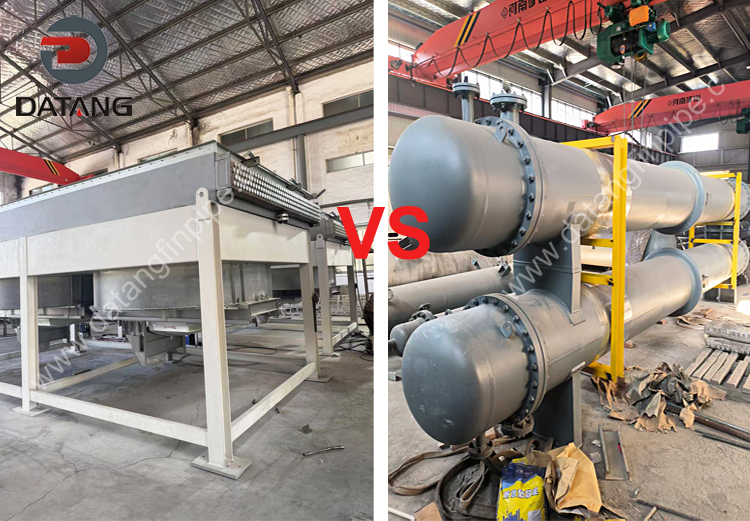
Both types of heat exchangers are widely used in industries such as oil and gas, petrochemical processing, chemical manufacturing, power generation, and industrial cooling. However, they use different cooling methods and have different requirements for installation, operation, maintenance, and utilities.
So, which one is better?
The answer depends on your process conditions, cooling medium, operating temperature and pressure, available utilities, installation space, and total operating cost.
This article explains the key differences between a Fin Fan Cooler and a Shell and Tube Heat Exchanger and provides practical guidance on how to choose the right solution.
What Is a Fin Fan Cooler?
A Fin Fan Cooler, also known as an Air Cooled Heat Exchanger (ACHE), uses ambient air to remove heat from a process fluid.
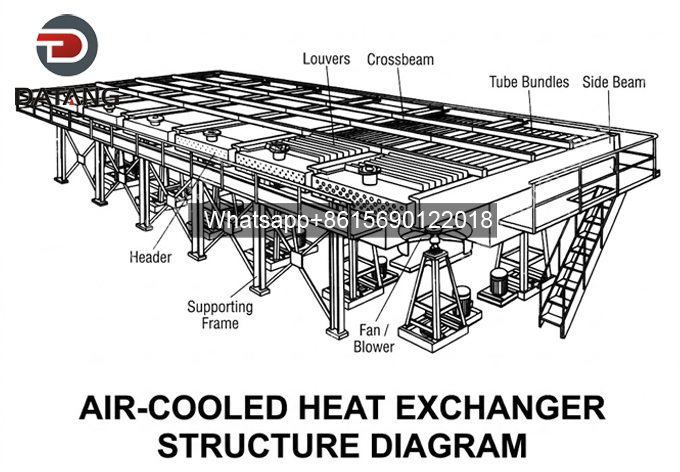
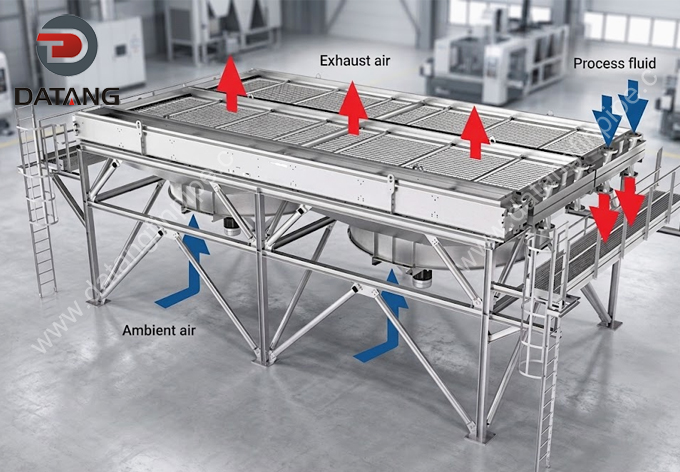
The hot process fluid flows through tubes equipped with extended fins. Fans force or induce ambient air across the finned tubes. Heat is transferred from the process fluid to the tube wall, then from the tube and fins to the surrounding air.
Because it uses air instead of cooling water, a Fin Fan Cooler can be an attractive option for plants where water availability is limited.
Main Components of a Fin Fan Cooler
- Finned Tubes: Extended metal surfaces (aluminum or copper fins) that maximize the heat transfer area on the air side.
- Tube Bundle(Tube sheets+Headers/boxes): Arrays of tubes connected to headers.
- Fans & Motors: Axial flow fans providing forced or induced air movement.
- Structure/Plenum: Steel frame casing directing airflow across the tubes.
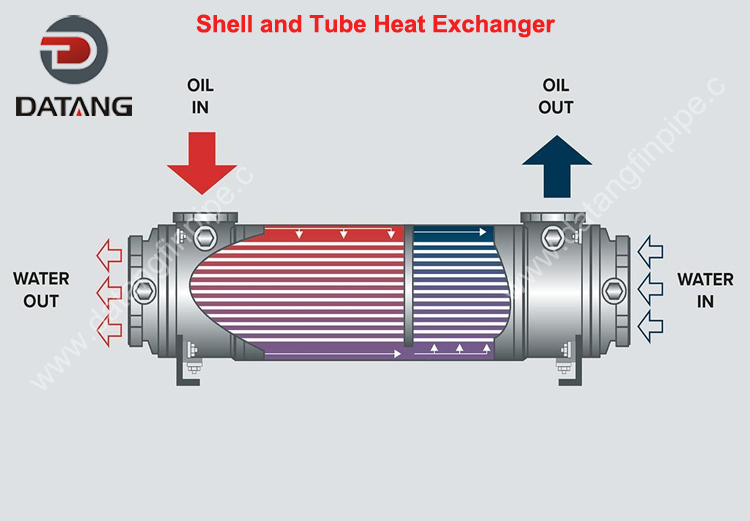
What Is a Shell and Tube Heat Exchanger?
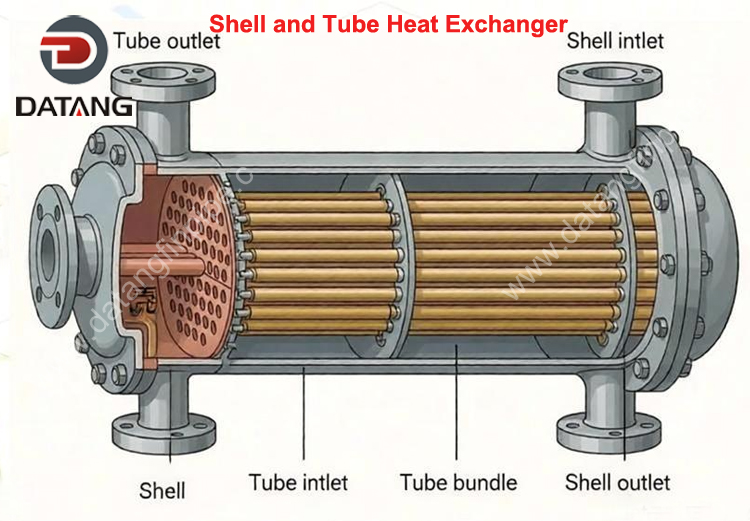
A Shell and Tube Heat Exchanger transfers heat between two fluids without directly mixing them.
One fluid flows through a bundle of tubes (tube side), while the other flows around the outside of the tubes inside the shell(shell side). Heat passes through the tube walls from the hotter fluid to the colder fluid.
Depending on the application, the cooling medium may be water, another process fluid, or another suitable heat-transfer medium.
Main Components of a Shell and Tube Heat Exchanger
- Shell: The pressure vessel housing the internal bundle.
- Tubes & Tube Sheets: The primary conduit for tube-side fluid, anchored by heavy perforated plates (tube sheets).
- Baffles: Internal plates that direct shell-side fluid flow across the tubes to maximize heat transfer rates and prevent flow-induced vibration.
- Tube bundle
- Channel or heads
- Nozzles
- Expansion components, depending on design
Fin Fan Cooler vs Shell and Tube Heat Exchanger: Key Differences
The most important difference is the cooling medium.
A Fin Fan Cooler uses ambient air, while a Shell and Tube Heat Exchanger commonly uses water or another fluid to transfer heat.
| Comparison | Fin Fan Cooler | Shell and Tube Heat Exchanger |
|---|---|---|
| Cooling medium | Ambient air | Water or process fluid |
| Heat transfer | Process fluid to air | Fluid to fluid |
| Cooling water | Not required | Usually required |
| Water consumption | Very low / none | Required in many applications |
| Ambient temperature impact | High | Relatively low |
| Installation area | Usually larger | Usually more compact |
| Fouling concern | Mainly air-side | Can occur on fluid side |
| Fan power | Required | Usually not required for the exchanger itself |
| Typical applications | Oil & gas, refineries, petrochemical | Chemical, power, HVAC, process industries |
| Best suited for | Plants with limited water | Plants with reliable cooling utilities |
Noted: The actual performance and cost will depend on the specific design and operating conditions. Therefore, these differences should be used as general selection guidelines rather than universal rules.
Fin Fan Cooler vs Shell and Tube: Advantages and Disadvantages
Fin Fan Cooler
Advantages of Fin Fan Coolers
1. No cooling water required
The main advantage is that the cooling medium is ambient air. This eliminates the need for cooling water consumption and can reduce dependence on cooling towers and water treatment systems.
2. Suitable for water-scarce locations
Fin Fan Coolers are particularly useful in remote areas, deserts, and industrial plants where reliable cooling water is unavailable or expensive.
3. Relatively simple cooling system
There is no cooling-water circuit, which can reduce issues associated with water treatment, fouling, scaling, and water-side corrosion.
4. Suitable for large industrial applications
Air-cooled heat exchangers are commonly used for process cooling and condensation in oil and gas and petrochemical facilities.
Limitations of Fin Fan Coolers
The performance of a Fin Fan Cooler depends significantly on the ambient air temperature. When outdoor temperatures are high, the temperature difference available for heat transfer decreases.
They can also require a relatively large installation area, and the fans consume electrical power during operation.
Shell and Tube Heat Exchangers
Advantages of Shell and Tube Heat Exchangers
1. High heat transfer efficiency
Liquid-to-liquid heat transfer generally provides a high heat transfer coefficient, making shell and tube exchangers suitable for many demanding process applications.
2. Compact design
Compared with some air-cooled systems, shell and tube heat exchangers can provide a large heat-transfer surface within a relatively compact package.
3. Wide range of applications
They can be designed for different fluids, temperatures, pressures, and process requirements.
4. Less dependent on ambient temperature
Because the cooling medium is normally a controlled process utility such as cooling water, performance is generally less directly affected by changes in outdoor air temperature.
Limitations of Shell and Tube Heat Exchangers
The main limitation is that many applications require a reliable cooling-water system.
Cooling water can also introduce problems such as:
- Fouling
- Scaling
- Corrosion
- Water treatment requirements
- Cleaning requirements
- Water consumption
Where Are Fin Fan Coolers Used?
Fin Fan Coolers are particularly common in industries where large amounts of process heat need to be rejected and cooling water is limited.
Typical applications include:
Oil and Gas
Fin Fan Coolers can be used to cool hydrocarbons and other process fluids in oil and gas facilities.
Refineries
They are widely used for process cooling and condensation duties in refinery units.
Petrochemical Plants
Air-cooled heat exchangers can be used in various process cooling and condensing applications.
Remote Industrial Facilities
Where water infrastructure is limited, air cooling can offer an important operational advantage.
Where Are Shell and Tube Heat Exchangers Used?
Shell and tube heat exchangers are among the most widely used heat-transfer equipment in industrial processing.
Typical applications include:
- Chemical processing
- Petrochemical plants
- Oil and gas
- Power generation
- HVAC systems
- Food processing
- Industrial manufacturing
- Heat recovery systems
They are especially useful when a suitable cooling fluid is readily available and a compact heat exchanger is preferred.
Quick Selection Criteria
Choose a Fin Fan Cooler when:
-
Cooling water is scarce, expensive, or restricted by environmental regulations.
-
The process fluid outlet temperature can remain above ambient dry-bulb temperature + 10–15°C margin.
-
Plot space is readily available (e.g., pipe rack mounting)
Choose a Shell and Tube Heat Exchanger when:
-
Process fluids must be cooled close to or below ambient air temperature.
-
Operating pressures/temperatures exceed standard air-cooled design limits.
-
Available installation footprint is strictly limited.
Conclusion
The comparison between a Fin Fan Cooler and a Shell and Tube Heat Exchanger is not simply about which equipment has better performance.
A Fin Fan Cooler uses ambient air and can significantly reduce or eliminate cooling-water requirements, making it attractive for water-scarce locations and many oil and gas applications.
A Shell and Tube Heat Exchanger uses two fluid streams and offers flexible heat-transfer configurations, making it suitable for a wide range of industrial processes.
When selecting between the two, engineers should consider heat duty, operating temperature and pressure, cooling medium, ambient conditions, water availability, installation space, maintenance requirements, and total cost of ownership.
Ultimately, the right heat exchanger is the one that provides reliable heat transfer while meeting the project’s technical, economic, and operational requirements.
Real Fin Fan Cooler Project
1.Air Cooled Heat Exchanger forAlgeria Refinery
2.Air Cooler and Air Cooler Fan for Iraq Refinery
3.How Datang’s Tailored Air CoolerSolutions Won Over MalaysianClients
