


Laser welded and high-frequency welded finned tubes are two types of fin tubes widely used in the field of heat exchange,each engineered for distinct operational demands. They have significant differences in manufacturing process, performance characteristics, application scenarios, etc.
Both of these finned tube welding processes are the main products manufactured by Datang Fin Tubes.
High Frequency Welded Fin Tubes vs Laser Welded Fin Tube

What Are High-Frequency Welded Fin Tubes?
High-frequency welded finned tubes are high-efficiency heat exchange elements that use a high-frequency welding process to weld fins (usually metal sheets) to the outer surface of a base tube. Utilizing the skin effect and proximity effect generated by high-frequency current, the metal is rapidly and locally heated to a molten state. Under pressure, the fins and base tube are metallurgically bonded, forming a continuous weld.
Manufacturers typically choose this technology for large-scale industrial projects because it combines consistent quality with competitive production costs.
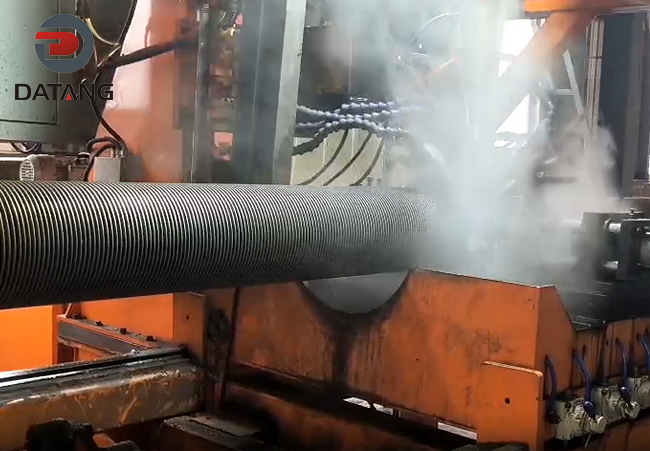
We Can Manufacture High-Frequency Welded Fin Tubes Specifications
| Parameter | Typical Range |
|---|---|
| Base Tube OD | 18–273 mm |
| Fin Height | 8–25 mm |
| Fin Thickness | 0.6–3.5 mm |
| Fin Pitch | 4–10 mm (1–8 FPI) |
| Tube Length | Up to 30 m |
| Tube Material | Carbon Steel, Stainless Steel (TP304/316/321), Alloy Steel,Duplex Steel |
Noted:These parameters meet the requirements of most boilers, economizers, air coolers, and waste heat recovery systems.
What Are Laser Welded Fin Tubes?
Laser welded fin tubes use high-energy laser beams as heat sources to weld the fins and the tube body together through precise laser welding technology. During the welding process, the high temperature generated by the laser beam instantly melts the contact surface between the fins and the tube body, and then forms a strong weld during the solidification of the molten pool.
Although laser welding has a higher manufacturing cost, it provides superior performance even in harsh environments.
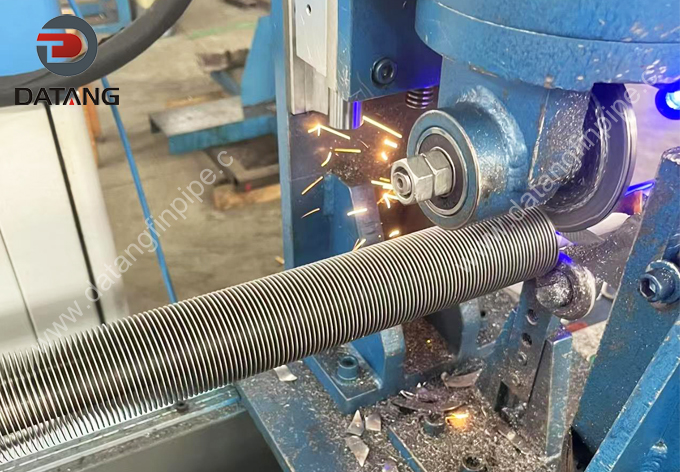
Parameters of laser-welded finned tubes we can produce
| Parameter | Typical Range |
|---|---|
| Base Tube OD | 10–60 mm |
| Fin Height | 5–20 mm |
| Fin Thickness | 0.3–1.0 mm |
| Fin Pitch | 2–10 mm(5–13 FPI) |
| Tube Length | Up to 24 m |
| Tube Material | Stainless Steel, Carbon Steel, Titanium, Nickel Alloy,Steel–Copper, Copper |
Noted:These specifications make laser welded fin tubes ideal for compact and high-performance heat exchangers.
High-frequency Welded Fin Tubes vs Laser Welded Fin Tube Parameters
| Parameter | High-Frequency Welded Fin Tubes | Laser Welded Fin Tubes |
|---|---|---|
| Welding Method | High-frequency induction/resistance welding | Focused laser beam welding |
| Fin-to-Tube Bond | Continuous metallurgical bond | Precise continuous metallurgical bond |
| Heat Input | Relatively higher | Very low and highly localized |
| Heat-Affected Zone (HAZ) | Small to moderate | Very small |
| Weld Precision | Good | Excellent |
| Weld Appearance | Visible weld line | Fine and uniform weld line |
| Fin Pitch | Typically suitable for standard/medium fin pitch | Particularly suitable for fine and dense fin pitch |
| Fin Thickness | Generally suitable for medium/thicker fins | Well suited to thin fins |
| Production Speed | High | Moderate |
| Production Efficiency | Excellent for high-volume production | High, but generally slower than HFW |
| Production Cost | Lower | Higher |
| Equipment Cost | Relatively lower | Higher |
| Material Compatibility | Mainly carbon steel, alloy steel and stainless steel | Carbon steel, stainless steel and various dissimilar metals can be used |
| Thermal Contact Resistance | Low | Very low when a continuous, sound weld is achieved |
| Heat Transfer Performance | Excellent | Excellent; can be higher in some designs |
| Corrosion Resistance | Good with proper welding and protection | Excellent weld integrity; reduced risk of interfacial gaps |
| Thermal Cycling Resistance | Good | Excellent |
| Vibration Resistance | Good | Excellent |
| High-Temperature Applications | Suitable for many industrial applications | Particularly suitable for demanding high-temperature applications |
| Maintenance Requirement | Low | Low |
| Best Application | General industrial heat exchangers, boilers, air coolers | High-performance, compact, corrosive or demanding heat exchangers |
| Main Advantage | Cost-effective + high production efficiency | Precision + low heat input + excellent bonding quality |
| Main Limitation | Less precise than laser welding | Higher manufacturing cost |
Noted:Both technologies provide reliable fin-to-tube bonding, but the optimal choice depends on fin geometry, material, operating temperature, corrosion conditions, production volume, and project budget.
Industrial Applications
High-Frequency Welded Finned Tubes
High-frequency welded finned tubes are widely used in numerous traditional industries, including:
- Boiler economizers
- Air preheaters
- Waste heat recovery systems
- Petrochemical plants
- Power plants
- Industrial furnaces
High-frequency welded finned tubes are the preferred choice when cost-effectiveness, reliable performance, and large heat exchange area are required.
Laser-welded finned tubes
Laser-welded finned tubes are suitable for demanding applications
- Liquefied natural gas vaporizers
- Hydrogen energy systems
- Marine and shipbuilding applications
- High-pressure heat exchangers
- Chemical equipment
- Nuclear and aerospace industries
- Compact design, high-performance heat exchangers
These industries prioritize the highest heat transfer efficiency and long-term reliability. Laser-welded finned tubes are suitable for applications with high requirements for efficiency, precision, corrosion resistance, and service life.
Which Fin Tube Should You Choose?
The right choice depends on your operating conditions and project budget.
Choose high-frequency welded fin tubes if your project requires high production volume, proven reliability, and competitive pricing. They provide excellent performance for most conventional heat exchangers while keeping investment costs under control.
Choose laser welded fin tubes if your system operates under high temperatures, high pressures, or corrosive environments. Although the initial investment increases, the higher efficiency and longer service life often reduce operating costs over time.
Conclusion
High-frequency welded finned tubes and laser-welded finned tubes each have their advantages and disadvantages, and are not suitable for all applications. High-frequency welded finned tubes combine reliable performance with low manufacturing costs, making them the preferred choice for standard industrial heat exchangers. Laser-welded finned tubes, on the other hand, offer higher thermal efficiency, higher overall efficiency, and superior long-life systems, thus performing exceptionally well in harsh environments requiring high material optimization and precision.
Before making a final decision, assess your operating temperature, pressure, corrosion conditions, thermal efficiency requirements, and project budget. By matching these parameters with the appropriate finned tube technology, you can maximize equipment performance and realize long-term operational value.
FAQ – High-Frequency vs Laser Welded Fin Tubes
Are laser-welded finned tubes more efficient than high-frequency welded finned tubes?
Yes. Laser-welded finned tubes allow for better thermal contact between the fins and the base tube, resulting in higher fin connection precision and thus higher heat transfer efficiency.
Which type of finned tube has a longer service life?
Laser-welded finned tubes typically have a longer service life in high-temperature and corrosive environments, while high-frequency welded finned tubes offer excellent durability in standard industrial applications.
Can laser welded fin tubes weld dissimilar materials?
Yes, laser welding can join different materials such as steel and copper.
Which fin tube is more cost-effective for large projects?
High-frequency welded fin tubes are typically more cost-effective for large-scale industrial applications.