


In industrial heat exchange and global supply chains, the process selection for high-efficiency heat exchange elements directly determines system thermal efficiency and operational lifespan. As an industrial manufacturing brand deeply rooted in the international market, Datang Finned Tube strictly executes high-standard quality control systems, providing tailored heat exchange solutions for global customers over the long term.
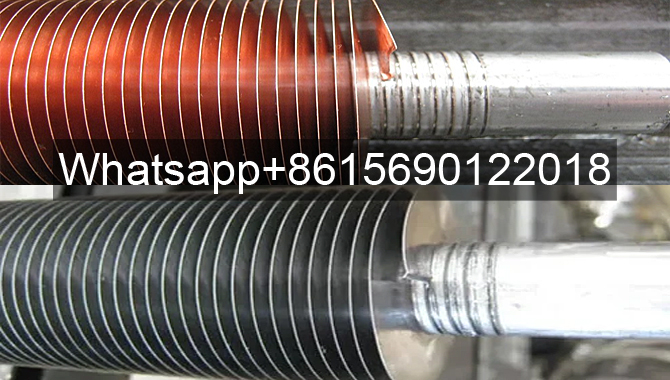
In the field of industrial heat exchange, L-type, LL-type, KL-type, and G-type (embedded) are the four most common types of high-efficiency wound/processed finned tubes. Their core difference lies in the bonding method between the fin and the base tube, which directly determines their temperature limits, corrosion resistance, heat transfer efficiency, and manufacturing costs.
Custom Finned Tube Manufacturing Services
At Datang Finned Tube, we understand that every heat transfer project comes with unique engineering challenges. That’s why we offer comprehensive, highly flexible Customization Services to meet your exact specifications and thermal design requirements.
Our Custom Capabilities Include:
-
Flexible Dimensions: Tailor-made tube diameters, wall thicknesses, fin heights, fin pitch (FPI), and fin thicknesses.
-
Ultra-Long Tube Handling: Specialized manufacturing and secure crating for ultra-long finned tubes to fit large-scale industrial heat exchangers.
-
Material Diversity: High-performance combinations including Carbon Steel, Stainless Steel (AISI 304/304L, 316/316L), Copper, and Aluminum to withstand various corrosive environments and temperatures.
-
Engineering Support: Production strictly according to your technical drawings, or collaborative thermal design assessments with our engineering team to find the optimal configuration.
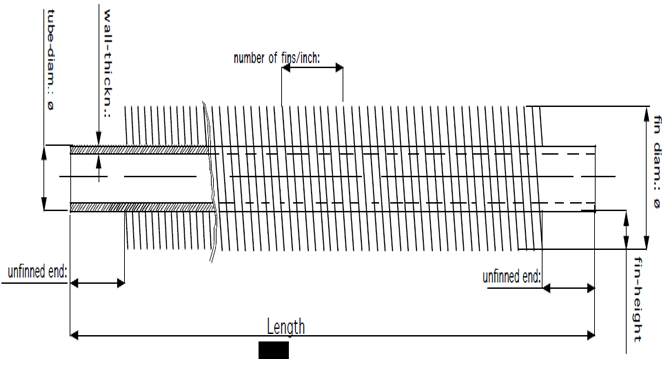
The following is a detailed comparison of the main differences, characteristics, and application scenarios of these four types of finned tubes:
L-Type Finned Tube (L Foot Fin Tube)
-
Manufacturing Process: The aluminum (or copper) strip is mechanically tension-wound onto the surface of the base tube. Its cross-section forms an “L” shape, tightly gripping the tube surface.
-
Characteristics:
-
The L-shaped foot covers a portion of the base tube, providing a certain degree of protection against atmospheric corrosion for the tube surface.
-
It relies entirely on mechanical tension for its tight grip. Due to thermal expansion and contraction, its contact thermal resistance increases at high temperatures.
-
-
Temperature Limit: The maximum operating temperature is typically 130°C to 150°C.
-
Main Applications: Commonly used in air coolers, air conditioning refrigeration, condensers, and industrial heat dissipation systems with lower temperatures and milder environmental corrosion. It is ideal for cost-sensitive, low-temperature operating conditions.
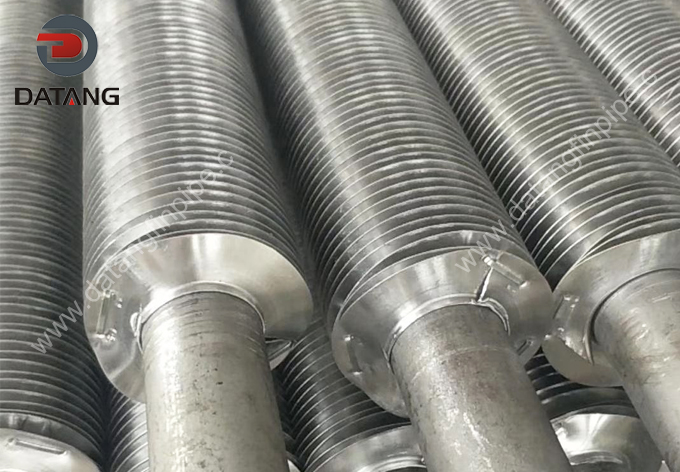
LL-Type Finned Tube (Double L / Overlapped L Fin Tube)
-
Manufacturing Process: This is an improvement based on the L-type fin. The fin foot is designed wider, causing the fin roots to completely overlap (double-cover) the outer surface of the base tube. During winding, the “L”-shaped foot of each subsequent turn completely overlaps and covers the previous turn.
-
Technical Characteristics:
-
100% Full-Wrap Corrosion Protection: The overlapping aluminum feet completely seal and isolate the base tube surface, blocking direct contact between the environmental media and the base tube.
-
Compared to the L-type, the LL-type provides tighter coverage over the base tube. Its resistance to atmospheric and salt spray corrosion far exceeds that of the L-type, significantly extending the service life of the tube bundle.
-
-
Temperature Limit: The maximum operating temperature is typically 170°C to 180°C.
-
Main Applications: Widely used in marine environments, petrochemical industries, and other specialized heat exchange systems with high humidity or salt spray where base tube corrosion protection is critical. It is ideal for low-to-medium temperature heat exchange scenarios with higher corrosion resistance requirements.
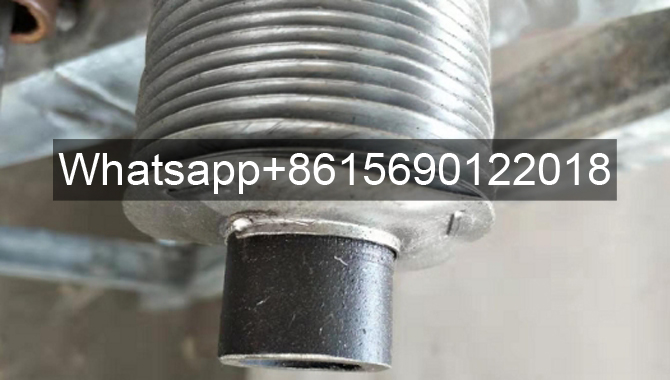
KL-Type Finned Tube (Knurled L Fin Tube)
-
Manufacturing Process: Prior to fin winding, specialized equipment is used to roll a uniform mesh pattern (knurling) onto the outer surface of the base tube. The L-shaped fin is then forcibly wound onto the knurled base tube and tightly locked into place through a secondary pressing process.
-
Technical Characteristics:
-
Extremely Low Contact Thermal Resistance: The knurling process exponentially increases the micro-contact surface area of the bonding interface, making heat transfer exceptionally efficient.
-
Vibration and Thermal Cycle Resistance: The bonding strength is extremely high, providing superior resistance to vibration. The fins will not loosen even under severe mechanical vibration or frequent thermal cycling.
-
-
Temperature Limit: The maximum operating temperature can reach 250°C to 280°C.
-
Main Applications: Suitable for medium-temperature operating conditions and environments with mechanical vibration. It is widely used in air coolers, air heaters, and spray drying systems within the petrochemical, power, papermaking, and tobacco industries.
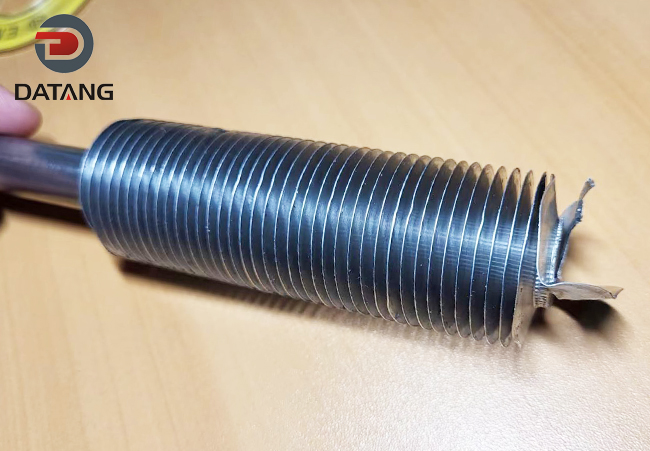
G-Type Finned Tube (Embedded Fin Tube)
-
Manufacturing Process: A precision mechanical tool is first used to cut a helical groove onto the surface of the base tube (typically 0.3 to 0.5 mm deep). The aluminum strip (or steel/copper strip) is then forcibly embedded into the groove under high tension. Finally, the displaced metal from the groove is rolled and pressed back against the root of the fin to achieve a secure mechanical lock.
-
Technical Characteristics:
-
Excellent High-Temperature Resistance and Thermal Stability: Because the fins are deeply embedded in the tube wall metal, the bond between the tube and the fin is exceptionally tight, resulting in extremely low contact thermal resistance. Even if the base tube and fins have different coefficients of thermal expansion at high temperatures, loosening will never occur, and the fins resist deformation. This guarantees continuous, stable, and high heat transfer efficiency.
-
The base tube is partially exposed at the groove, making its corrosion resistance weaker than that of the fully covered LL-type.
-
-
Temperature Limit: The operating temperature can reach 350°C to 400°C (with a maximum limit of 400°C), making it the most temperature-resistant type among wound and embedded finned tubes.
-
Main Applications: Suitable for severe operating conditions involving high temperatures, high pressures, and requirements for exceptionally high heat transfer efficiency. It is widely used in power plant boiler economizers, high-pressure air coolers, oil refineries, high-temperature flue gas waste heat recovery systems, and energy-saving units in the petroleum and chemical industries.
-
Main Applications (Alternative Summary): Commonly used in power station boilers, economizers, waste heat recovery units, and energy-saving systems for the petroleum and chemical sectors.
Core Parameter Comparison Table (Datang Finned Tube Selection Guide)
| Characteristic / Fin Type | L-Type Finned Tube | LL-Type Finned Tube | KL-Type Finned Tube | G-Type (Embedded) Finned Tube |
| Bonding Method | Surface tension wound | Surface overlapped wound | Wound after base tube knurling | Embedded into helical groove of base tube |
| Max. Temperature Resistance | ~ 150°C | ~ 180°C | ~ 250°C | ~ 400°C |
|
Corrosion Resistance (Base Tube Protection) |
Moderate | Excellent (Full coverage) | Moderate | Relatively weak |
|
Heat Transfer Efficiency (Thermal Resistance) |
Good | Good | Excellent | Exceptional (Stable at high temps) |
| Mechanical Vibration Resistance | Average | Average | Excellent | Extremely strong |
| Process Difficulty & Cost | Economical | Moderate | Relatively high | High |
How to Choose the Right Finned Tube
-
-
Temperature Resistance Ranking (Max Operating Temperature): L-Type < LL-Type < KL-Type < G-Type (Embedded)
-
Fin-to-Tube Bonding Strength & Heat Transfer Efficiency Ranking: L Fin < LL Fin < KL Fin < G Fin
-
Manufacturing Cost Ranking (Price Comparison): L-Type < LL-Type < KL-Type < G-Type
-
During actual selection, factors such as the equipment’s operating temperature, environmental corrosiveness, mechanical vibration conditions, and project budget must be comprehensively evaluated to choose the most suitable finned tube type.
-
Operating Temperature Higher temperatures generally require more robust fin-to-tube bonding methods, such as G fins.
-
Corrosive Environments For coastal or chemical environments, LL-type and G-type finned tubes typically deliver superior long-term performance.
-
Mechanical Stress For application scenarios involving vibration or thermal expansion, utilizing KL-type or G-type configurations may be more suitable.
-
Project Budget For many standard heat exchanger systems, L-type finned tubes remain a highly economical and practical choice.
-
Maintenance Requirements More durable fin structures help minimize maintenance costs and extend the overall service life of the equipment.
By understanding the differences among these fin processing methods, engineers and procurement teams can select the most appropriate solution for their specific operating conditions. Choosing the right finned tube not only maximizes heat exchanger efficiency but also helps minimize maintenance costs and extend the overall service life of the equipment.
If you are looking for custom finned tube solutions, our team can provide you with L-type, LL-type, KL-type, and G-type (embedded) finned tubes, as well as high-frequency welded (HFW) finned tubes, laser-welded finned tubes, and extruded aluminum (bimetallic) finned tubes. All of these products are custom-manufactured to meet your specific requirements.
Why Choose Datang Finned Tube?
As a seasoned veteran in industrial manufacturing and global export, Datang Finned Tube is not only equipped with advanced automated winding and grooving machinery but also adheres to rigorous testing protocols (such as hydrostatic testing and precision dimensional checks). This ensures that every single finned tube leaving our factory delivers superior bonding tightness and heat transfer performance. Our engineering team is always ready to provide you with the most cost-effective finned tube selection and thermal calculation services based on your specific operating parameters.
