


In heat exchanger design and selection, finned tubes (featuring Datang Finned Tube solutions) and bare tubes (also referred to as plain tubes) are two fundamental heat transfer components. Their core difference stems from the size of their heat exchange surface area, directly determining their suitable working conditions and application scenarios.
At the heart of heat exchanger design lies a continuous balancing act among heat transfer surface area, equipment cost, installation footprint, and thermal efficiency. For engineers and procurement teams alike, the core decision always comes down to value: Does the increased structural complexity needed to boost efficiency pay off, or is a simpler design more cost-effective over its entire operational lifecycle?
This tradeoff is especially critical when evaluating bare tube vs. finned tube heat exchangers, particularly in space-constrained or high-performance applications:
-
Finned Tube Heat Exchangers: Often the go-to solution when external surface area must be significantly extended to maximize heat transfer efficiency. However, their selection requires careful evaluation of manufacturing costs, maintenance complexity, and ambient operating conditions.
-
Bare Tube (Plain Tube) Heat Exchangers: Excel in liquid-to-liquid applications where film coefficients on both sides are high and thermal resistance is low. Thanks to their straightforward structure, resistance to fouling, and ease of cleaning, they remain an invaluable choice for many industrial processes.
Leading manufacturers like Datang provide a comprehensive range of heat exchanger solutions across diverse fin types, materials, and structural configurations. Ultimately, making the right choice requires aligning your application’s core functional demands and operating limits to achieve the optimal balance between performance, budget, and long-term maintainability.
Core Heat Transfer Principles
The overall heat transfer rate of a heat exchanger is governed by the basic design equation:
Where U represents the overall heat transfer coefficient, A is the total heat transfer surface area, and ▵Tm is the Logarithmic Mean Temperature Difference (LMTD).
Bare Tubes (Plain Tubes)
For bare tubes, the heat transfer surface area A is strictly limited to the inner and outer boundary surfaces of the smooth pipe. When the convective heat transfer coefficients of the fluids inside and outside the tube are balanced and relatively high (water-to-water or oil-to-water systems), bare tubes deliver uniform and highly efficient thermal performance.
Finned Tubes
Finned tubes feature thin metal fins attached to or extruded onto the outer (or inner) base tube wall, expanding the total surface area by several times—or even tens of times. This design primarily addresses conditions with highly unbalanced heat transfer coefficients across the tube wall (for example, high-coefficient steam or water inside the tube paired with low-coefficient air or flue gas outside). Adding fins to the weak thermal resistance side substantially boosts both the effective surface area A and the overall heat transfer coefficient U.
What is a Bare Tube (Plain Tube)?
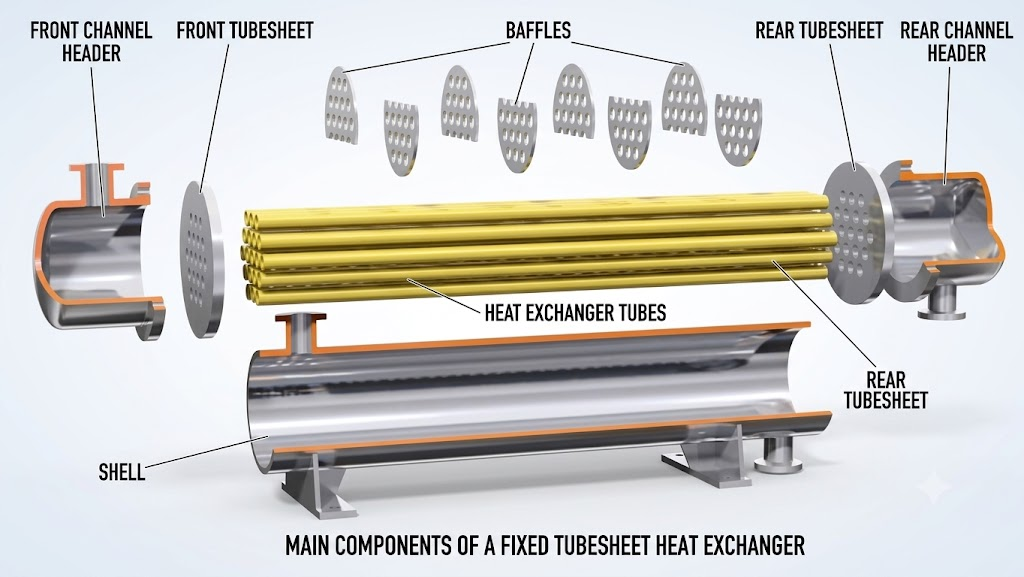
A bare tube (also known as a plain tube) refers to a pipe with smooth inner and outer walls, completely free of any added extended surface or fins. It is widely used as a foundational component in standard heat exchangers that require substantial total surface area. Common materials used to manufacture these tubes include carbon steel, stainless steel, and copper alloys—with the specific material chosen based on operating pressure, temperature, and corrosion-resistance requirements.
-
Key Characteristics: Featuring a simple structure and low manufacturing cost, its smooth surface makes it resistant to ash/fouling accumulation and easy to clean and maintain.
-
Thermal Performance: Its heat transfer surface area is strictly limited to the tube wall itself, resulting in a relatively lower heat transfer rate compared to finned designs.
-
Ideal Applications: It is typically suitable for operating conditions where the heat transfer coefficients of the fluids inside and outside the tube are comparable (such as water-to-water or single-phase gas-to-gas heat transfer). Bare tubes are also highly recommended for severe fouling fluids, as the absence of fins prevents heavy deposit accumulation and simplifies mechanical cleaning.
What is a Finned Tube?
A finned tube is a heat exchanger tube that enhances heat transfer surface area by incorporating external (or internal) fins onto a standard base tube (bare tube). These enhanced tubes enable more efficient heat exchange with the surrounding medium through an expanded contact area without increasing the overall footprint of the equipment.
-
Core Function: Substantially boosts the overall heat transfer rate by significantly extending the surface area on the side with a lower heat transfer coefficient.
Key Advantages
-
High Thermal Efficiency: By dramatically expanding the surface area, finned tubes significantly intensify heat transfer. They effectively elevate thermal performance when handling media with low heat transfer coefficients, such as air, gases, or viscous fluids. Depending on the operating environment, various fin designs can be utilized—including embedded fins (G-type), wrapped fins (L/KL/LL-type), extruded fins, and low-fin tubes—each offering distinct advantages regarding working temperatures and operating costs. Additionally, custom material combinations can be selected to match performance requirements. Paired setups—such as carbon steel tubes with aluminum fins, or stainless steel tubes with copper fins—are specifically engineered to optimize thermal conductivity while mitigating corrosion risks.
-
Compact Footprint: To achieve the same heat duty, the required tube count and total heat exchanger volume are drastically reduced, saving valuable installation space and raw material costs.
-
Cost Savings: While the unit cost of an individual finned tube is higher than that of a bare tube, the total capital expenditure and installation cost for the entire heat exchanger are often lower due to the reduced equipment scale and structural footprint.
-
Ideal Applications: Primarily used in scenarios where the heat transfer coefficients of the internal and external fluids differ significantly—most commonly in gas-to-liquid heat exchange. Because gas side heat transfer coefficients are typically much lower than those of liquids, adding fins on the gas side effectively addresses this bottleneck. Common applications include air conditioning systems, automotive radiators, and air preheaters.
Key Differences between Finned Tubes vs Bare Tubes
| Comparison Dimension | Finned Tube | Bare Tube / Plain Tube |
| Extended Surface Area | Extremely High (2 to 20 times higher than plain tubes of the same specification) | Standard Surface Area (limited strictly to the outer and inner tube walls) |
| Equipment Volume & Weight | Smaller footprint and lighter weight for the same thermal duty | Requires larger volume and a higher tube count for gas heat transfer |
| Optimal Fluid Pairs | Gas-to-liquid, gas-to-gas, and evaporation/condensation | Liquid-to-liquid, high-pressure/high-viscosity liquids, and fouling-inclined media |
| Fluid Resistance (Pressure Drop / Air Resistance) | Higher external gas flow resistance (higher pressure drop) | Lower flow resistance with a more uniform flow field distribution |
| Fouling & Cleaning | Fin gaps easily trap dust/scale; online cleaning is more challenging | Smooth surface prevents heavy accumulation; easy to mechanically clean and maintain |
| Manufacturing Cost | Higher material and processing requirements; higher individual tube cost | Simple structure; lower individual manufacturing cost |
| Maintenance | Requires careful cleaning method | Easier cleaning |
| Temperature Range | Depends on fin attachment method | Wide |
Typical Application Scenarios
1.When to Choose Finned Tubes
-
Air Coolers / Air Radiators: Ambient air serves as the cooling medium, while water, thermal oil, or refrigerant flows inside the tubes.
-
Boiler Economizers & Waste Heat Recovery Systems: Flue gas waste heat is utilized to heat feedwater. Because the flue gas side has a low heat transfer coefficient, high-frequency welded (HFW) or laser-welded spiral finned tubes are required.
-
HVAC Evaporators & Condensers: Copper tube with aluminum fin heat exchangers widely used in air conditioning systems.
-
Gas-to-Liquid or Gas-to-Gas Processes: When one side involves gas or low-thermal-conductivity vapor, heat transfer efficiency drops. Finned tube heat exchanger types—such as Embedded G-type finned tubes—are ideal because they significantly increase surface area and enhance heat transfer efficiency.
-
Space-Constrained Installations: Finned tubes provide a much larger heat transfer area within a smaller physical footprint. Consequently, they are exceptionally well-suited for offshore platforms, skid-mounted systems, and other space-restricted installation environments.
2.When to Choose Bare Tubes (Plain Tubes)
-
Liquid-to-Liquid Shell & Tube Heat Exchangers: Such as water-to-water heat exchangers or oil-to-water coolers.
-
High-Fouling / High-Dust Environments: Process media containing large particulate impurities, or substances prone to coking and heavy fouling (e.g., crude oil, unfiltered exhaust gas).
-
Extreme High-Pressure or Highly Corrosive Environments: Eliminating extra structural processing preserves the structural integrity, pressure-bearing performance, and continuous corrosion resistance of the base tube.
-
Steam Condensing Services: When steam condenses on the shell side, the initial heat transfer coefficient is exceptionally high. In such cases, adding fins is unnecessary; using bare tubes directly avoids introducing complex structural complications.
-
Budget-Conscious Projects: For projects with strict performance demands but limited capital budgets, bare tubes offer a highly viable solution. Installation and maintenance are simpler and significantly lower in cost.
Advantages of Finned Tubes and Bare Tubes
Finned Tube
Finned tubes enhance heat transfer by adding external fins to the base tube, thereby expanding the effective surface area.
-
High Heat Transfer Efficiency: The addition of fins drastically increases the surface area—reaching several to tens of times that of a plain tube—which significantly boosts overall thermal performance.
-
Compact Structure: To achieve the same heat duty, the required tube count and overall heat exchanger footprint are substantially reduced, saving valuable installation space.
-
Lower Overall Cost: Although individual finned tubes carry a higher manufacturing cost than bare tubes, the reduced tube count often leads to lower overall material, fabrication, and installation costs for the entire heat exchanger.
-
Enhanced Equipment Performance: Fins increase structural rigidity, improve vibration resistance, and contribute to lower long-term operating costs.
Bare Tube (Plain Tube)
A bare tube refers to a pipe with smooth surfaces, completely free of any added extended surfaces or fins.
-
Resistant to Fouling and Dust Accumulation: The smooth surface prevents dust and grime build-up, offering strong anti-fouling capability and maintaining long-term, stable thermal performance.
-
Easy Cleaning and Maintenance: Highly accessible for both mechanical flushing and chemical cleaning, which keeps maintenance costs low and minimizes downtime for servicing.
-
Sturdy and Durable Structure: Free from extra attached structures like fins, the tube is robust as a whole—providing strong resistance to impact and vibration, making it less prone to mechanical damage.
-
Low Fluid Resistance: The smooth surface and unobstructed profile yield low air or fluid resistance (pressure drop), ensuring quieter equipment operation and lower energy consumption.
Disadvantages of Finned Tubes and Bare Tubes
Finned Tube
-
Prone to Fouling and Clogging: The densely spaced fin structure easily traps dust, dirt, and particulates—especially in dusty gas environments. This restricts airflow and causes thermal performance to deteriorate over time.
-
Difficult Cleaning and Maintenance: Once dust accumulates or scaling occurs, cleaning is significantly more complex than with smooth bare tubes, often requiring system shutdown for specialized maintenance.
-
Risk of Contact Thermal Resistance: For finned tubes fabricated using non-welded processes (such as mechanical tension winding), microscopic gaps can exist between the fin and the base tube. Under prolonged thermal cycling or equipment vibration, these gaps may widen, increasing contact thermal resistance and degrading heat transfer efficiency.
-
Diminishing Returns on Fin Height: Taller or denser fins are not inherently better. Excessively high or overly dense fins not only increase manufacturing complexity and cost, but also lead to lower fin efficiency (thermal effectiveness discount), accelerated fouling, and a reduced operational lifespan.
Bare Tube (Plain Tube)
-
Limited Heat Transfer Surface Area: The surface area is strictly restricted to the boundary of the tube wall itself, resulting in a relatively low heat transfer rate. In high-heat-load applications, this requires significantly more tubes and a much larger total equipment footprint.
-
Bulky Equipment Footprint: To achieve the same thermal capacity as a finned tube heat exchanger, a substantially larger installation footprint is required, making the equipment far less compact.
-
Higher Overall Material Cost: For applications demanding high heat duty, deploying a large quantity of bare tubes increases total raw material requirements, driving up overall equipment fabrication costs.
Common Pitfalls in Finned Tube vs. Bare Tube Selection
-
Prioritizing Thermal Efficiency While Ignoring Operating Conditions: Blindly pursuing high heat transfer efficiency without accounting for high-dust or severe-fouling environments leads to rapid fin clogging and performance degradation.
-
Focusing Solely on Unit Price While Ignoring Total Lifecycle Cost: Opting for lower initial procurement costs often backfires in harsh operating conditions, resulting in premature equipment failure and skyrocketing long-term operation, maintenance, and replacement costs.
-
Blindly Pursuing Excessive Fin Density: Assuming that denser fins are inherently better is a misconception. Overly dense fins are extremely prone to dust accumulation and localized corrosion, which creates redundant, wasted heat transfer surface area.
-
Neglecting Material Compatibility and Process Quality: Overlooking galvanic corrosion caused by contact between dissimilar metals, or using tension-wound finned tubes with weak bonding strength in high-pressure or high-vibration applications, can compromise structural integrity.
-
Ignoring Installation and Maintenance Clearances: Failing to reserve adequate air flow passages and maintenance space drastically drops heat exchanger efficiency and makes post-fouling cleaning and servicing nearly impossible.
Conclusion: Making the Right Choice Between Finned and Bare Tubes
In summary, choosing between finned tubes and bare tubes is not a matter of which technology is superior, but rather which solution best aligns with your specific operating conditions, system thermodynamics, and budget constraints.
-
Choose Finned Tubes (such as high-efficiency Datang Finned Tubes) when your system involves gas-to-liquid or gas-to-gas heat transfer, where one side presents a low thermal transfer coefficient. They excel in space-restricted environments where compact footprint and high thermal efficiency are paramount.
-
Choose Bare Tubes when operating in liquid-to-liquid applications with balanced thermal coefficients, severe fouling/dust environments, or extreme high-pressure and corrosive conditions that require simple maintenance and maximum structural integrity.
By thoroughly evaluating the full lifecycle cost—balancing upfront capital expenditure against long-term maintenance, pressure drop, and operational reliability—engineers and procurement teams can ensure optimal thermal performance and maximum ROI for their heat exchanger systems.
