


Finned tubes and heat exchanger tubes are industrial heat transfer components. They facilitate the transfer of heat between fluids or gases and their surrounding environment by allowing thermal energy to pass through the tube wall—between the medium inside the tube and the fluid outside it. These components are widely used in sectors such as power generation, HVAC and refrigeration, the petrochemical industry, oil and gas, and boiler waste heat recovery.
Heat exchanger tube is a general term that encompasses both plain tubes and finned tubes. A finned tube is a specialized, enhanced type of heat exchanger tube.
What are heat exchanger tubes?
Heat exchanger tubes,also called heat transfer tubes,they are the core heat-transfer components within a heat exchanger. They are primarily used to facilitate the transfer of heat between two fluids at different temperatures, typically without allowing the fluids to mix. These tubes are generally made of metal, with heat passing through the tube walls from the higher-temperature fluid to the lower-temperature fluid.
Depending on their structure, heat exchanger tubes can be categorized into types such as plain (or bare) tubes and finned tubes. They are widely used in the chemical, petroleum, power generation, and refrigeration industries, as well as in various industrial heat-exchange equipment.
Common materials include carbon steel, stainless steel, duplex stainless steel, copper alloys, titanium alloys, and nickel alloys.
Typical structural configurations include straight tubes, U-tubes, seamless tubes, and welded tubes.
Applications include shell-and-tube heat exchangers, condensers, evaporators, and other industrial heat-transfer equipment.
What is a finned tube?
A finned tube is a type of heat-transfer tube featuring fins attached to the surface of a standard (plain) tube; it consists of a base tube and external fins. The base tube carries the process fluid, while the fins increase the heat-transfer surface area on the outside of the tube. By expanding the external (or sometimes internal) surface area, the design enhances heat transfer and improves thermal efficiency, effectively overcoming the limitations of plain tubes,their small heat transfer surface area and high thermal resistance.
Fins help intensify heat transfer, particularly when air, flue gas, or other gases flow over the exterior of the tube. Since the heat-transfer coefficient of gases is typically lower than that of liquids, increasing the external surface area helps boost overall heat-transfer performance.When the external heat transfer coefficient is significantly lower than that of the fluid inside the tubes, the available heat transfer surface area can become a bottleneck, limiting overall heat transfer efficiency. This is a primary reason to consider using finned tubes.
Common materials: Carbon steel, stainless steel, alloy steel, aluminum, and copper.
Common fin types: Welded, extruded, embedded, L-type/LL-type/KL-type, G-type, and spiral fins.
Applications: Boiler economizers, air-cooled heat exchangers in power plants, metallurgical heat exchangers, air heaters, and industrial waste heat recovery systems.
Finned Tubes vs. Plain Heat Exchanger Tubes: Key Differences
| Comparison | Plain Heat Exchanger Tubes | Finned Tubes |
| External Structure | Smooth tube surface | Fins attached to the outer tube surface |
| External Heat Transfer Area | Relatively small | Larger external area |
| Main Function | Basic heat transfer | Enhanced external heat transfer |
| Suitable Fluid Side | Liquid or gas | Gas-to-liquid heat transfer |
| Heat transfer | Depends on tube size and flow conditions | Often improved on the finned side |
| Application | Condensers, Shell-and-tube exchangers | Air coolers, economizers, heating coils |
| Equipment Size | Depends on the design | May help reduce equipment size |
| Air-side Pressure Drop | Generally lower | Depends on fin spacing and geometry |
| Cleaning and Maintenance | Generally exterior is easier to clean | Fins can accumulate dust and debris |
| Manufacturing Cost | Generally lower | Depends on material, manufacturing process and design |
Important note: While finned tubes increase external surface area, this does not necessarily mean that the total heat transfer rate will increase by the same proportion. The actual performance is also influenced by factors such as the heat transfer coefficients on the tube’s inner and outer surfaces, fouling resistance, fin efficiency, flow velocity, and the equipment’s structural design.
When selecting finned tubes, the decision should always be based on thermal design rather than solely on the surface area. If you are unsure how to make a selection, please contact the Datang technical team; we will provide you with thermal calculations and system design solutions.
How Do Finned Tubes Enhance Heat Transfer?
In many industrial heat exchangers, the gas side is often the primary source of resistance to heat transfer.
Finned tubes improve heat transfer by increasing the external surface area available for heat exchange. This is particularly important in applications where air or flue gas flows over the tubes, as the heat transfer coefficient for gases is generally lower than that for liquids; simply increasing the number of bare (unfinned) tubes is often not the most practical solution.
1. Why is a larger external surface area needed?
Fins provide additional external surface area without requiring an increase in the number or length of the base tubes, or the overall footprint of the equipment, thereby enabling greater heat transfer.
2. The connection between fins and tubes
Heat must first be transferred from the base tube to the fins, and then from the fins to the surrounding air. If the connection between the fin and the base tube is poor, contact thermal resistance increases, which degrades heat transfer performance. Different manufacturing processes result in different connection structures; the most appropriate process should be selected based on specific operating conditions.
3. How do fin height, spacing, and structure affect performance?
Fin height and spacing influence both the heat transfer area and the airflow characteristics.
Fin height and thickness
Fin height determines the available external surface area. However, increasing fin height does not always yield a proportional improvement in heat transfer performance, as heat must be conducted through the material of the fin itself.
The thickness and material of the fins also affect fin efficiency, mechanical strength, and thermal conductivity.
Fin spacing
Fin spacing refers to the distance between adjacent fins.
Smaller spacing allows for more fins to be arranged along a given tube length, thereby increasing the available surface area. However, if the fins are too tall or the spacing is too narrow, it can lead to a higher pressure drop on the gas side and make cleaning more difficult—especially in dusty environments.
For applications involving flue gas or air containing suspended particles, fin spacing must be considered with great care. If you are unsure about which finned tube configuration to choose, please contact Cangzhou Datang; we can provide guidance on selecting the right solution for your needs.




Common Applications of Finned Tubes and Heat Exchanger Tubes
Heat exchanger tubes and finned tubes are essential components in industrial heat exchange systems. They are widely used in the petrochemical, power generation, metallurgy, refrigeration and environmental industries. Their applications vary depending on the fluid, operating conditions and heat transfer requirements.
Applications of Finned Tubes
Finned tubes are mainly used where air or gas is involved in heat transfer. They provide more external surface area and help improve heat transfer in a limited space.
Air-Cooled Heat Exchangers
In refineries and chemical plants, air-cooled heat exchangers use air instead of water to cool process fluids. Bimetallic extruded finned tubes and high-frequency welded finned tubes are commonly used in these systems.
Waste Heat Recovery Systems
Finned tubes are installed in the flue gas paths of industrial furnaces, gas turbines and boilers. They recover heat from hot exhaust gases and use it to preheat feedwater or combustion air.
HVAC and Refrigeration
Finned tubes are used in large air conditioning systems, air handling units, heating coils and dry coolers. They help transfer heat between air and the working fluid inside the tubes.
Industrial Drying Equipment
Finned tubes are used in air heating systems for food processing, grain drying and wood drying. They provide the heat needed to maintain the required drying temperature.
Applications of Plain Tubes (Heat Transfer Tubes)
Plain tubes have a smooth surface without external fins. They offer lower flow resistance on the outside and are generally easier to clean. They are commonly used when the heat transfer area is sufficient or when fouling and cleaning are important considerations.
Shell-and-Tube Heat Exchangers
Plain tubes are widely used in chemical plants, pharmaceutical facilities and water treatment systems. They support heat exchange between liquids, gases and steam.
Boiler Water Walls and Heating Surfaces
Plain tubes are used in boiler water walls and other heating surfaces. They absorb heat from the furnace and transfer it to the water inside the tubes to produce steam.
Condensers and Evaporators
Plain tubes are commonly used in refrigeration systems, seawater desalination plants and industrial evaporation equipment. They support the condensation and evaporation processes required for heat exchange.
When Should You Choose Finned Tubes or Plain Heat Exchanger Tubes?
Choosing between plain tubes and finned tubes is a critical engineering decision that depends on heat transfer requirements, operating conditions, and equipment design. No single tube type is suitable for every application. The key lies in identifying where the primary thermal resistance to heat transfer exists and determining the amount of heat transfer surface area required.
Choose Plain Heat Exchagner Tubes:
Balanced Heat Transfer: The heat transfer coefficients on the inside and outside of the tube are relatively balanced (In liquid-to-liquid heat exchange).
Sufficient Surface Area: The surface area of standard plain heat exchanger tubes is already adequate to meet the thermal design capacity, with no need for additional heat transfer area.
Ease of Maintenance and Cleaning: The working fluids are prone to fouling, scaling, or crystallization, necessitating frequent, straightforward mechanical or chemical cleaning.
No Need for Extended Surface Area: The operating environment does not require additional external surface area to compensate for low heat transfer performance on the gas side.
For liquid-to-liquid heat exchangers,and in any application where the required heat load can be achieved without the use of fins,plain heat transfer tubes are generally the most practical choice.
Choose Finned Tubes:
Gas-Side Heat Transfer Bottleneck: Outside the tube, air, flue gas, or exhaust gas flows with a low convective coefficient, making the gas side the primary barrier to heat transfer.
Tight Space Constraints: The unit needs maximum thermal surface per cubic foot to keep overall dimensions and footprint down.
Strict Performance Targets: The project demands high thermal efficiency and exact heating or cooling capacity within rigid physical limits.
Favorable Operating Conditions: The gas stream is relatively clean or manageable, allowing the finned geometry to run without fouling issues and fit standard maintenance routines.
Selecting between plain and finned tubing is not just about packing in extra surface area. It comes down to matching the tube geometry to your real-world process dynamics. If you are unsure which setup fits your system best, reach out to the Datang technical team. We will evaluate your operating conditions and help you select the exact tube specification for your project.
Common Types of Finned Tubes Used in Industrial Heat Exchangers
| Type | Main Features | Image |
|---|---|---|
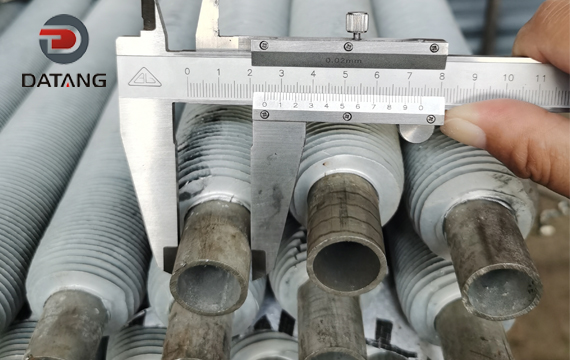
| Extruded Finned Tube | Fins are formed by mechanical extrusion, creating a tight bond between the fin layer and the base tube. Fin type: smooth and serrated fins.[Learn more about Extruded Finned Tubes →] |
 |
| Embedded G-Type Finned Tube | The fin strip is mechanically embedded into a helical groove on the base tube.
[Learn more about Embedded G-Type Finned Tubes →] |
 |
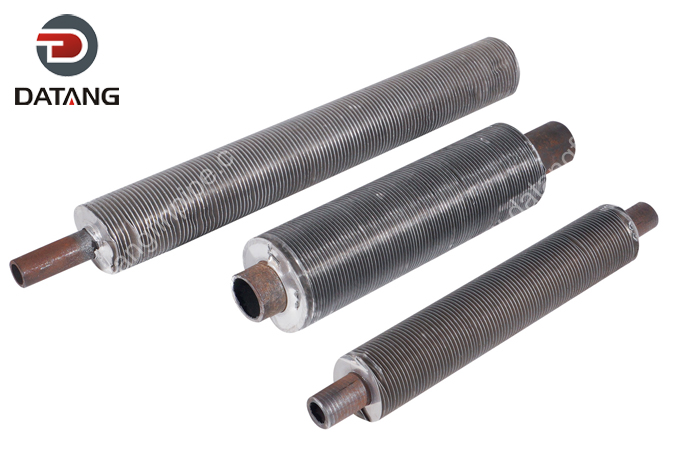
| L/LL/KL Finned Tube | Fins are secured to the base tube using different wrap-on fin configurations. Commonly used in air-cooled heat exchangers and other applications that require a balance between operating temperature, corrosion resistance, and manufacturing costs. [Learn more about L/LL/KL Finned Tubes →] |
 |
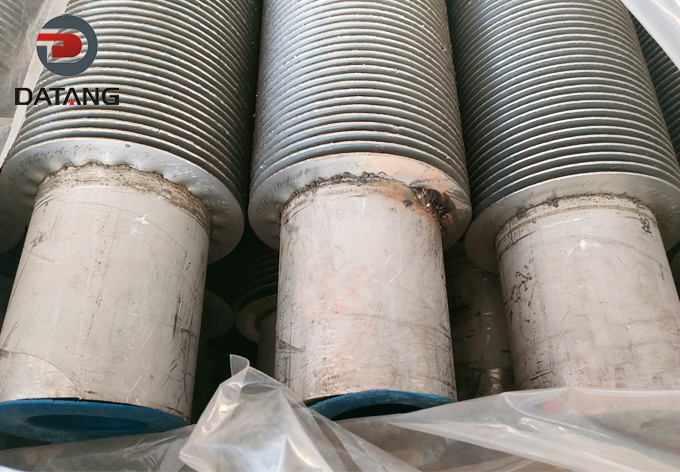
| High-Frequency Welded Finned Tube | High-frequency welded finned tubes are manufactured by continuously welding a spiral fin strip onto the base tube. They are widely used in industrial boilers, economizers, waste heat recovery equipment and other applications requiring a welded fin connection. [Learn more about High-Frequency Welded Finned Tubes →] |
 |
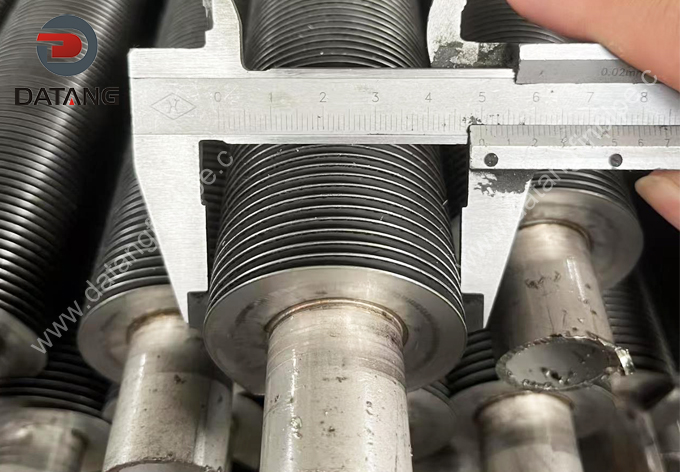
| Laser Welded Finned Tube | Laser welding is used to connect the fins to the base tube.
[Learn more about Laser Welded Finned Tubes →] |
 |
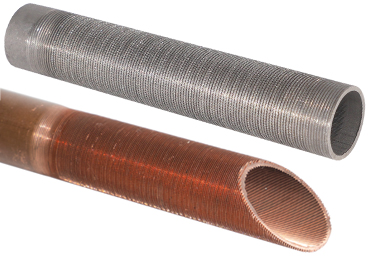
| Integral Low Finned Tube | Low fins are formed directly from the outer wall of the base tube through cold rolling. They are commonly used in condensers, evaporators and other heat transfer equipment where additional external surface area is needed within a compact design. [Learn more about Integral Low Finned Tubes →] |
 |
Common Industrial Standards for Heat Transfer Tubes and Finned Tubes
When purchasing plain tubes (bare tubes) or finned tubes, the applicable standards depend on the equipment type, operating environment, design pressure, temperature and material requirements.
Datang follows these standards to control product quality and meet project requirements.
Common Standards for Plain Heat Exchanger Tubes (Bare Tubes)
Standards for plain heat transfer tubes mainly cover base tube materials, manufacturing processes, dimensional tolerances, mechanical properties and inspection requirements.
| Standard | Main Requirements | Common Applications |
|---|---|---|
| ASTM A179/A179M | Seamless cold-drawn low-carbon steel tubes for heat exchangers and condensers | Shell-and-tube heat exchangers and condensers |
| ASTM A213/A213M | Seamless ferritic and austenitic alloy steel boiler, superheater and heat exchanger tubes | Boilers, superheaters and industrial heat exchangers |
| ASTM A192/A192M | Seamless carbon steel boiler tubes for high-pressure service | High-pressure boiler heating surfaces |
| EN 10216-2 | Seamless non-alloy and alloy steel tubes with specified high-temperature properties | High-temperature pressure equipment |
| EN 10216-5 | Seamless stainless steel tubes for pressure purposes | Corrosion-resistant and pressure equipment |
It is important to understand that material standards, tube manufacturing standards and heat exchanger design codes are not the same. When inspecting heat transfer tubes, checking compliance with ASTM or ASME standards alone is not enough. The fin structure, bonding method, dimensional tolerances and inspection requirements must also be clearly defined.
Common Standards for Finned Tubes
In addition to the base tube material standards, finned tubes require attention to fin structure, attachment method, fin dimensions, bonding quality and operating temperature.
| Standard | Main Requirements | Application |
|---|---|---|
| ASTM A498/A498M | Requirements for carbon steel tubes with integral fins | Integral low finned tubes and related products |
| API 661 | Design, materials, fabrication, inspection and testing requirements for air-cooled heat exchangers | Air-cooled heat exchangers in the oil, gas and petrochemical industries |
| TEMA Standards | Design, fabrication and inspection requirements for shell-and-tube heat exchangers | Shell-and-tube heat exchangers and related tube bundles |
Design Codes for Heat Exchange Equipment
In addition to tube and finned tube standards, industrial projects may also require compliance with equipment design codes.
| Standard | English Name | Main Application |
|---|---|---|
| ASME BPVC Section I | Rules for Construction of Power Boilers | Power boilers and industrial boilers |
| ASME BPVC Section VIII | Rules for Construction of Pressure Vessels | Pressure vessels and related equipment |
| ASME BPVC Section II | Materials | Material specifications and properties |
| ASME BPVC Section V | Nondestructive Examination | Nondestructive testing |
| ASME BPVC Section IX | Welding, Brazing, and Fusing Qualifications | Welding and related procedure qualifications |
| ASME B31.3 | Process Piping | Process piping in the oil, chemical and industrial sectors |
These codes cover equipment design, material selection, fabrication and inspection. The applicable sections depend on the equipment type and project requirements.
Frequently Asked Questions
1.Can finned tubes replace plain heat exchanger tubes?
Not in every application. The selection depends on the equipment design, thermal requirements, mechanical conditions and available space. A thermal evaluation is needed before changing the tube type.
2.What materials are commonly used for finned tubes?
Common base tube materials include carbon steel, stainless steel and alloy steel. Fin materials include aluminum, copper and steel. The appropriate combination depends on temperature, corrosion conditions and the required fin connection.
3.What information is required for a finned tube inquiry?
For project inquiries, please provide the following details:
Base tube material and dimensions
Fin material, height, and spacing
Tube length and fin arrangement
Technical drawings (if available)
Datang technical team can assist in assessing your requirements and provide manufacturing and technical support for your finned tube projects.
