


When selecting an industrial cooling system, plant engineers and procurement managers often have to decide between a fin fan cooler and a cooling tower. Both systems can remove heat from industrial processes, but they work in fundamentally different ways and have different requirements for water consumption, operating conditions, maintenance, energy use, and installation.
A fin fan cooler, also known as an air cooled heat exchanger (ACHE) or air fin cooler, uses ambient air to remove heat directly from a process fluid. A cooling tower, by contrast, typically uses evaporative cooling to remove heat from circulating water.
So, which one is better?
The answer depends on your process requirements, ambient conditions, water availability, required outlet temperature, cooling duty, and total lifecycle cost.
This guide compares fin fan coolers vs cooling towers and explains when each technology is the better choice.
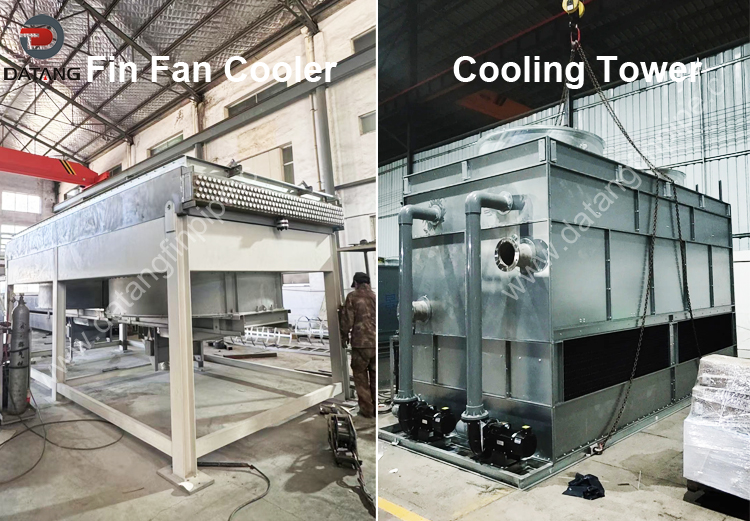
Fin Fan Cooler vs Cooling Tower: Quick Comparison
| Factor | Fin Fan Cooler | Cooling Tower |
|---|---|---|
| Cooling medium | Ambient air | Water and air |
| Main cooling mechanism | Air-side heat transfer | Evaporative cooling |
| Direct process-fluid cooling | Yes | Usually indirect |
| Water consumption | Little to none for heat rejection | Requires make-up water |
| Main environmental factor | Dry-bulb temperature | Wet-bulb temperature |
| Water treatment | Generally not required for the cooling medium | Required |
| Water-related maintenance | Minimal | Regular |
| Main power requirement | Fans | Fans and circulating pumps |
| Best suited for | Direct process cooling and water-scarce sites | Centralized cooling-water systems |
| Typical industries | Oil & gas, petrochemical, LNG, power | Power, HVAC, chemical, manufacturing |
The most important distinction is simple:
A fin fan cooler uses air to cool the process fluid, while a cooling tower uses evaporative cooling to cool circulating water.
What Is a Fin Fan Cooler?
A fin fan cooler is an air-cooled heat exchanger designed to remove heat from a process fluid using ambient air.
It is widely used in industries where process fluids such as hydrocarbons, natural gas condensates, chemicals, and other liquids need to be cooled without relying on a continuous supply of cooling water.
How Does a Fin Fan Cooler Work?
In a typical fin fan cooler, the hot process fluid flows through tubes equipped with extended fins. Fans move ambient air across the outside surface of the tubes.
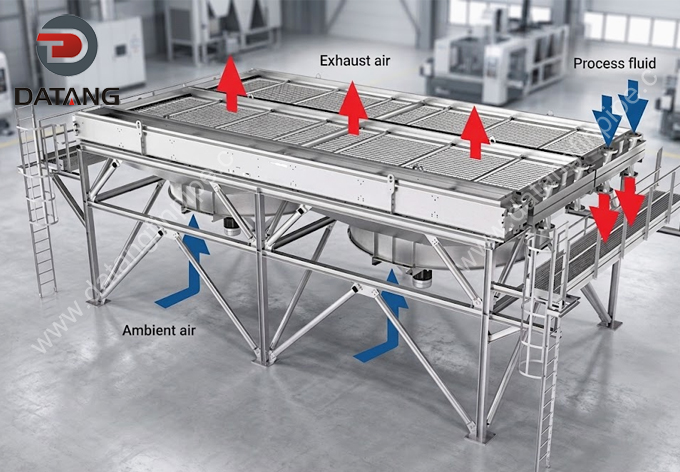
The heat transfer process can be summarized as:
Hot process fluid → tube wall → fins → ambient air → atmosphere
The fins increase the external heat-transfer surface area, while the fans provide the required airflow across the tube bundle.
Depending on the application, fans can be arranged in forced-draft or induced-draft configurations.
Main Components of a Fin Fan Cooler
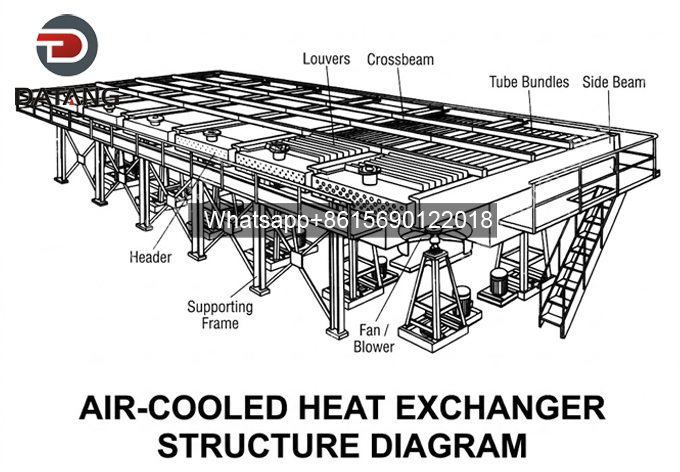
A typical air cooled heat exchanger may include:
- Finned tube bundle
- Headers
- Fans
- Fan blades
- Electric motors
- Plenum or fan housing
- Structural frame
- Louvers
- Vibration monitoring equipment
- Fan control system
The exact configuration depends on the required thermal duty, process conditions, ambient temperature, materials, and project specifications.
Typical Fin Fan Cooler Applications
Fin fan coolers are commonly used in:
- Oil and gas processing
- Petroleum refineries
- Petrochemical plants
- Natural gas processing
- LNG facilities
- Power generation
- Chemical plants
- Compressor stations
- Process plants
For example, in an oil refinery, an air cooled heat exchanger can be used to cool hydrocarbons after a process unit without requiring a large cooling-water system.
What Is a Cooling Tower?
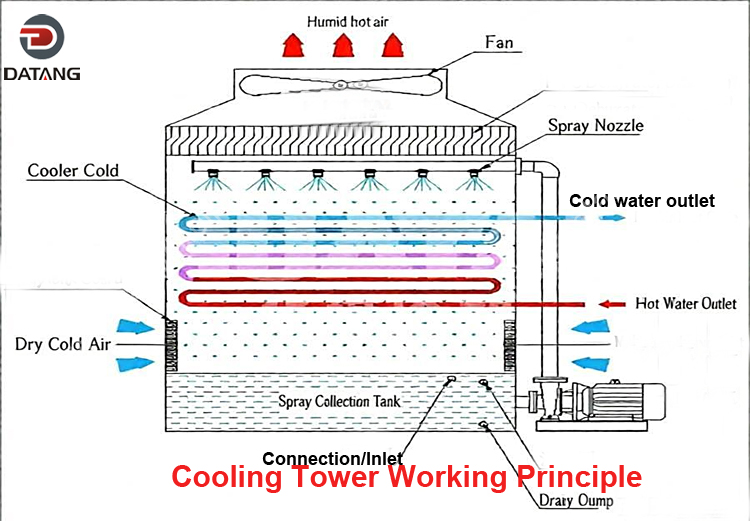
A cooling tower is a heat-rejection system.Unlike a fin fan cooler, a cooling tower typically uses water as the circulating cooling medium and relies on evaporative cooling to reject heat to the atmosphere.
Instead of cooling the process fluid directly with ambient air, a cooling tower normally cools water that is then circulated through heat exchangers or other process equipment.
How Does a Cooling Tower Work?
Warm circulating water enters the cooling tower and is distributed over a fill material or through spray nozzles.
Air passes through the tower, allowing a portion of the water to evaporate. The evaporation process removes heat from the remaining circulating water.
The simplified process is:
Warm water → air/water contact → evaporation → heat rejection → cooled water
The cooled water is then returned to the industrial cooling system.
Main Components of a Cooling Tower
- Tower Fill (Packing): Plastic or PVC sheets structured to maximize water-to-air contact time and surface area.
- Water Distribution System: Spray nozzles, headers, and piping that uniformly disperse hot water across the fill.
- Cold Water Basin: Collection reservoir at the base of the tower that holds cooled water for pump suction.
- Drift Eliminators: Baffled structures that capture entrained water droplets from the exiting exhaust air stream.
- Circulating Pumps & Piping: High-volume pump systems dedicated to routing water between the tower and process exchangers.
Cooling towers are widely used where a centralized cooling-water system is required for multiple process users.
Common Industrial Applications
- Centralized HVAC and district cooling plants
- Power generation steam condensers (wet cooling)
- Steel mills and heavy metal manufacturing
- Municipal chemical processing facilities
- Food and beverage manufacturing plants
Fin Fan Cooler vs Cooling Tower: How Do They Differ?
Although both systems reject heat, the differences become important when evaluating a real industrial project.
| Factor | Fin Fan Cooler | Cooling Tower |
|---|---|---|
| Cooling medium | Air | Water + Air |
| Cooling mechanism | Sensible heat transfer | Mainly evaporative cooling |
| Water consumption | Very low / none | Significant |
| Cooling approach | Limited by ambient air temperature | Can approach wet-bulb temperature |
| Water treatment | Usually not required | Required |
| Installation | Relatively simple | Requires water system |
| Maintenance | Relatively low | Higher |
| Fouling/scaling | Mainly air-side fouling | Water-side fouling/scaling |
| Corrosion | Depends on materials/environment | Water chemistry can increase corrosion |
| Footprint | Can be large | Generally compact for equivalent duty |
| Noise | Fan noise | Fan + water noise |
| Suitable for water-scarce areas | Excellent | Less suitable |
| Typical application | Process fluid cooling | Recirculating water cooling |
Cooling Performance: Dry-Bulb vs Wet-Bulb Temperature
Ambient conditions are one of the most important factors when comparing an air cooled heat exchanger with a cooling tower.
Fin Fan Cooler and Dry-Bulb Temperature
Fin fan cooler performance is strongly influenced by ambient dry-bulb temperature.
As ambient air temperature increases, the temperature difference available for heat transfer generally decreases.
For this reason, a fin fan cooler operating in a very hot environment may require:
- Larger heat-transfer surface area
- Higher airflow
- More fans
- Larger equipment
- Additional cooling stages
- Special design considerations
The required process outlet temperature should therefore always be evaluated against the site’s design ambient temperature.
Cooling Tower and Wet-Bulb Temperature
Cooling towers are strongly influenced by ambient wet-bulb temperature.
Because cooling towers rely on evaporative cooling, they can generally cool circulating water toward the ambient wet-bulb temperature rather than simply the dry-bulb temperature.
This can give cooling towers an important advantage when a process requires relatively low cooling-water temperatures.
Why Does This Difference Matter?
Consider two plants with the same heat-rejection requirement but different site conditions.
A water-scarce site may favor a fin fan cooler because it can reduce or eliminate cooling-water consumption.
A site with abundant water and a favorable wet-bulb temperature may find a cooling tower attractive when low cooling-water temperatures are required.
Therefore, climate and process temperature requirements should be evaluated together rather than separately.
Water Consumption Comparison
Water consumption is often one of the biggest factors in the decision between a fin fan cooler and a cooling tower.
Fin Fan Cooler Advantage
Fin fan coolers operate as entirely closed, dry systems. They consume no water during operation, eliminating the need for:
-
Continuous fresh make-up water infrastructure
-
Chemical anti-scalants, corrosion inhibitors, and biocide dosing (Legionella control)
-
Environmental permitting and discharge management for blowdown wastewater
Cooling Tower Requirements
Cooling towers experience continuous water losses through evaporation, mechanical drift, and necessary blowdown discharges to control dissolved solids. In arid regions—such as the Middle East, North Africa, Australia, and Western North America—the costs and environmental restrictions associated with sourcing fresh make-up water often make cooling towers impractical or cost-prohibitive.
Energy Consumption: Fin Fan Cooler vs Cooling Tower
Determining which system consumes less power requires evaluating total system parasitics rather than fan horsepower alone.
Fin Fan Total Power = Fan Motor Power
Cooling Tower Total Power = Fan Motor Power + Water Circulation Pump Power + Water Treatment Systems
Fin Fan Coolers: Power consumption is restricted to the electric fan drives. Installing Variable Frequency Drives (VFDs) or automated louver controls allows energy draw to scale down significantly during off-peak ambient hours or winter months.
Cooling Towers: While tower fans may require less airflow power per megawatt of rejected heat due to evaporative cooling efficiency, the system requires high-flow circulating water pumps to push water through the cooling loop and heat exchangers, alongside chemical dosing feed systems.
Neither system is universally more energy efficient. The better option depends on the required outlet temperature and local climate.
Maintenance Comparison
Maintenance requirements are another important difference.
Fin Fan Cooler Maintenance Tasks
-
Periodic visual inspection of fan belts, bearings, and electric drives
-
External air-side tube bundle cleaning using low-pressure air, water, or foam sprays to remove dust and debris
-
Vibration monitoring of heavy axial fan assemblies
Cooling Tower Maintenance Tasks
-
Daily or automated water quality monitoring (pH, total dissolved solids, chlorine/biocide levels)
-
Regular removal of bio-slimes, algae, and mineral scale from thermal fill packing and spray nozzles
-
Basin sediment removal and structural rust mitigation
-
Compliance testing for biological pathogens, specifically Legionella pneumophila
CAPEX, OPEX and Total Cost of Ownership
Choosing between a fin fan cooler and a cooling tower should not be based solely on equipment purchase price.
Capital Expenditure (CAPEX)
Fin Fan Coolers generally carry a higher initial equipment purchase cost. The requirement for extensive extended-surface finned tubing, alloy metallurgy, heavy structural frames, and multiple fan bays increases baseline manufacturing costs.
Cooling Towers frequently present a lower upfront equipment cost for equivalent thermal duties due to compact plastic fill media and high heat transfer coefficients.
Operating Expenditure (OPEX)
Fin Fan Coolers maintain extremely low ongoing operating expenses. They require zero water charges, zero water treatment chemicals, and minimal labor hours for maintenance.
Cooling Towers incur persistent, compounding operational expenditures: ongoing municipal water supply fees, continuous chemical dosing purchases, blowdown sewage charges, and frequent mechanical and chemical maintenance.
Total Lifecycle Cost
A lower equipment purchase price does not necessarily mean a lower lifecycle cost.
For a project with expensive water, limited water availability, or high water-treatment costs, the long-term operating advantages of an air cooled heat exchanger can be significant.
Over a 10-to-20-year equipment lifecycle, the zero-water operational savings of a fin fan cooler often offset its higher initial capital cost, yielding a favorable Total Cost of Ownership (TCO).
A proper comparison should therefore consider:
CAPEX + energy + water + chemicals + maintenance + expected operating life
Fin Fan Cooler vs Cooling Tower for Different Climates
The best cooling technology depends strongly on the project location.
| Site Condition | Potentially Preferred Solution |
| Water scarcity | Fin Fan Cooler |
| Abundant water supply | Cooling Tower may be attractive |
| Very low required cooling temperature | Cooling Tower may have an advantage |
| Direct process-fluid cooling | Fin Fan Cooler |
| High ambient temperature | Requires detailed thermal evaluation |
| Hot and dry climate | Fin Fan Cooler can reduce water demand |
| High humidity | Cooling tower performance should be evaluated against wet-bulb conditions |
| Cold climate | Fin fan cooler can be effective with appropriate winterization |
There is no universal answer based only on climate.
For example, a hot climate does not automatically mean that a cooling tower is the better choice. The required process outlet temperature, water availability, and overall economics must also be considered.
Typical Industrial Applications
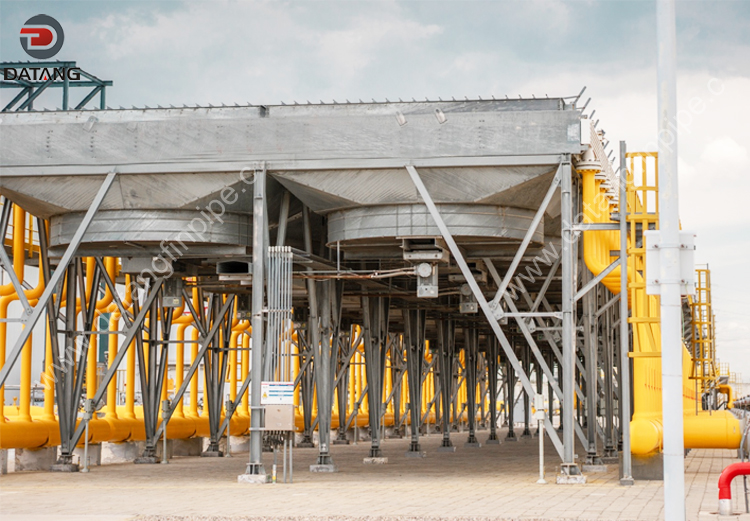
Fin Fan Cooler Applications
Fin fan coolers are especially common in:
Oil and Gas
They can be used for cooling hydrocarbons, condensates, lubricating oils, compressor fluids, and other process streams.
Refineries
Air cooled heat exchangers can be used in multiple refinery process units where process fluids need to be cooled before further processing or storage.
Petrochemical Plants
Fin fan coolers can provide reliable process cooling without requiring a dedicated cooling-water circuit for every application.
LNG and Natural Gas Processing
Air cooled heat exchangers are widely considered for applications where process fluids must be cooled and water availability is limited.
Power Generation
Air cooling can be used for various auxiliary and process cooling duties depending on plant configuration.
Cooling Tower Applications
Cooling towers are often used when a plant needs a centralized source of cooling water.
Typical applications include:
- Power plants
- HVAC systems
- Chemical plants
- Manufacturing facilities
- Steel plants
- Industrial process cooling
A cooling tower can be particularly useful when multiple pieces of equipment require circulating cooling water.
When Should You Choose a Fin Fan Cooler?
A fin fan cooler may be a strong choice when:
- Water availability is limited
- Water consumption must be minimized
- Direct process-fluid cooling is required
- Cooling-water treatment is undesirable
- The required outlet temperature can be achieved with ambient air
- The process involves hydrocarbons or other suitable process fluids
- The plant wants to reduce cooling-water infrastructure
- Long-term water and chemical costs are important considerations
For oil and gas, petrochemical, LNG, and other process industries, an appropriately designed air cooled heat exchanger can provide reliable heat rejection while significantly reducing dependence on cooling water.
Not Sure Whether a Fin Fan Cooler Can Meet Your Process Requirements?
Our engineers can evaluate your process conditions and determine whether an air cooled heat exchanger is suitable for your application.
[Request a Fin Fan Cooler Quote]
When Should You Choose a Cooling Tower?
A cooling tower may be more suitable when:
- A large centralized cooling-water system is required
- Multiple process units need cooling water
- Very low cooling-water temperatures are required
- Water is readily available
- Local wet-bulb conditions are favorable
- Evaporative cooling provides a significant thermal advantage
The key is to evaluate the cooling tower as part of the complete cooling-water system rather than as an isolated piece of equipment.
Can Fin Fan Coolers and Cooling Towers Be Used Together?
Yes.
Fin fan coolers and cooling towers do not always have to compete with each other.
In some industrial facilities, they can be used as complementary technologies within a hybrid cooling system.
For example:
Process Fluid → Fin Fan Cooler → Process Unit
while:
Cooling Water → Heat Exchangers → Cooling Tower → Cooling-Water System
A plant may use air cooling where direct process cooling is practical and cooling water where evaporative cooling provides better thermal performance.
This approach can help engineers optimize:
- Water consumption
- Energy consumption
- Cooling performance
- Equipment footprint
- Operating cost
- Process reliability
The optimal configuration depends on the specific process and site conditions.
How to Choose the Right Cooling System
Before selecting a fin fan cooler or cooling tower, engineers should evaluate at least the following parameters:
Required Cooling Duty
Determine the amount of heat that must be rejected.
Process Fluid
Important properties may include:
- Flow rate
- Density
- Viscosity
- Specific heat
- Thermal conductivity
- Corrosiveness
- Fouling tendency
Inlet and Outlet Temperatures
The required process outlet temperature is particularly important for determining whether ambient air can provide sufficient cooling.
Ambient Conditions
For an air cooled heat exchanger, design dry-bulb temperature is critical.
For a cooling tower, wet-bulb temperature is a key design parameter.
Water Availability
Evaluate:
- Water price
- Water availability
- Water quality
- Water-treatment requirements
- Discharge requirements
Energy Costs
Consider the complete electrical demand of the cooling system, including fans, pumps, and auxiliary equipment.
Maintenance Requirements
Evaluate not only mechanical maintenance but also water treatment, cleaning, corrosion control, and other recurring activities.
Total Cost of Ownership
Compare lifecycle costs rather than equipment purchase price alone.
Why Choose Our Fin Fan Coolers?
Selecting a fin fan cooler is not simply a matter of choosing a standard piece of equipment.
The heat exchanger should be designed around your actual process conditions and project requirements.
Our fin fan cooler solutions can be engineered according to factors such as:
- Process fluid
- Flow rate
- Inlet temperature
- Required outlet temperature
- Design ambient temperature
- Design pressure
- Material requirements
- Fouling conditions
- Fan configuration
- Tube and fin configuration
- Project standards
For demanding applications such as oil and gas, refinery, petrochemical, LNG, and power projects, proper thermal and mechanical design is essential for reliable long-term operation.
Request a Fin Fan Cooler Quote
If you are comparing a fin fan cooler vs cooling tower for a new project, our engineering team can help evaluate the appropriate cooling solution.
For a preliminary fin fan cooler selection, please provide as much of the following information as available:
- Process fluid
- Flow rate
- Inlet temperature
- Required outlet temperature
- Design ambient temperature
- Operating pressure
- Design pressure
- Fluid composition
- Fouling factor
- Required quantity
- Project location
- Applicable design standard
Need Help Selecting an Air Cooled Heat Exchanger?
Send us your process conditions and project requirements for a preliminary technical evaluation and quotation.
[Request a Quote] | [Contact Our Engineers]
Frequently Asked Questions
What is the difference between a fin fan cooler and a cooling tower?
A fin fan cooler uses ambient air to remove heat directly from a process fluid through finned tubes. A cooling tower primarily uses evaporative cooling to remove heat from circulating water. The two systems therefore have different water, temperature, maintenance, and infrastructure requirements.
Does a fin fan cooler use water?
A fin fan cooler normally does not require cooling water for its primary heat-rejection process. It uses ambient air as the cooling medium, which can significantly reduce water consumption compared with evaporative cooling systems.
Is a fin fan cooler more energy efficient than a cooling tower?
Neither system is universally more energy efficient. Energy consumption depends on cooling duty, required outlet temperature, ambient conditions, fan and pump efficiency, equipment design, and operating conditions. A complete system-level comparison is required.
Can a fin fan cooler replace a cooling tower?
In some applications, yes. If the required process outlet temperature can be achieved using ambient air and direct air cooling is practical, a fin fan cooler may eliminate the need for a cooling tower for that particular duty. However, a detailed thermal and economic evaluation should be performed before making the decision.
Which is better for water-scarce areas?
A fin fan cooler is often attractive for water-scarce areas because it uses ambient air instead of relying on evaporative cooling water. However, high ambient temperatures can affect air cooler performance, so the required outlet temperature must be checked carefully.
What temperature can a fin fan cooler achieve?
The achievable outlet temperature depends on ambient dry-bulb temperature, process conditions, heat-transfer area, airflow, fin and tube configuration, and the required temperature approach. Final performance must be determined through application-specific thermal design.
What industries use fin fan coolers?
Fin fan coolers are widely used in oil and gas, refineries, petrochemical plants, LNG and natural gas processing, power generation, chemical processing, and other industrial applications.
What is the difference between an air cooler and a cooling tower?
An air cooler, including a fin fan cooler, normally uses air to cool a process fluid directly. A cooling tower uses evaporation to cool circulating water. An air cooler therefore avoids the cooling-water system required by a typical cooling tower application.
How do I select a fin fan cooler?
Selection requires process information such as fluid type, flow rate, inlet and outlet temperatures, operating and design pressure, ambient temperature, fouling conditions, and material requirements. A qualified thermal and mechanical design should be performed before final equipment selection.
Can fin fan coolers and cooling towers be used together?
Yes. In some industrial plants, fin fan coolers and cooling towers are used together as part of a hybrid cooling strategy. Each technology can be assigned to the cooling duty where it provides the best combination of thermal performance, water consumption, energy use, and operating cost.
Final Verdict: Fin Fan Cooler vs Cooling Tower
There is no single cooling technology that is best for every industrial application.
A fin fan cooler can be an excellent choice when the project prioritizes:
- Low water consumption
- Direct process-fluid cooling
- Reduced water-treatment requirements
- Simpler water-free operation
- Operation in water-scarce regions
A cooling tower can be advantageous when the plant requires:
- Centralized cooling water
- Very low cooling-water temperatures
- Large-scale circulating-water cooling
- Favorable wet-bulb conditions
- Readily available water resources
The right decision should ultimately be based on cooling duty, process temperatures, ambient conditions, water availability, energy consumption, maintenance requirements, CAPEX, and total lifecycle cost.
If you are unsure whether a fin fan cooler can meet your required cooling duty, providing your process conditions to an experienced heat-exchanger manufacturer is the best way to determine the appropriate configuration.
Need a customized fin fan cooler for your project? Contact our engineering team for a preliminary design review and quotation.
