


From oil refineries to petrochemical plants, various industrial heat exchange processes rely on heat exchangers to transfer thermal energy. As one of China’s renowned heat exchanger manufacturers, Datang provides a diverse range of heat exchangers for various application fields, backed by strict quality control and advanced technology. Among industrial heat exchange equipment, double-tube (or double-pipe) and shell-and-tube are two common types of tubular heat exchangers.
Differences in Structure
-
Double-Pipe (Double Tube) Heat Exchangers
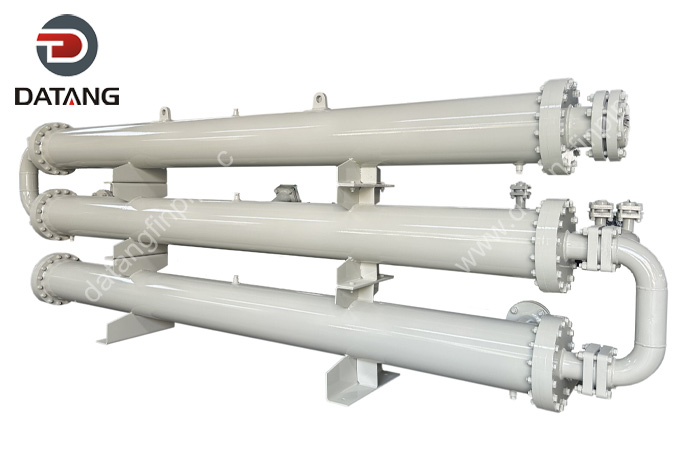
Consist of two concentric pipes of different diameters, often configured in a U-shape layout. The hot and cold fluids flow through the inner pipe and the outer pipe’s annular space, respectively, to perform heat exchange.
-
Shell-and-Tube Heat Exchangers
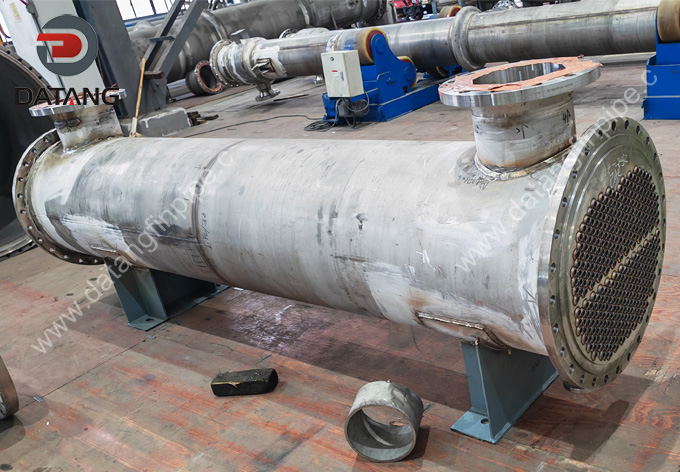
Consist of a cylindrical shell, an internal tube bundle, tube sheets, baffles, and other components. One fluid flows inside the tubes (tube side), while the other fluid flows outside the tube bundle through the shell (shell side) to transfer heat.
Operating Scenarios
-
Double Tube Heat Exchangers
Typically used for low flow rates under high pressure, media prone to fouling, and low-temperature anti-freezing scenarios.
-
Shell-and-Tube Heat Exchangers
Used for general large-scale industrial heat exchange, large temperature differences with high pressure and high temperature, highly corrosive or special media, and low-pressure, high-fouling conditions that require frequent maintenance.
Heat Transfer Efficiency
-
Double-Pipe Heat Exchangers
Offer moderate baseline heat transfer efficiency, which can be optimized and improved by modifying the inner tube structure (such as adding spiral grooves or fins to the inner pipe).
-
Shell-and-Tube Heat Exchangers
Provide a higher overall heat transfer coefficient, as baffles can significantly enhance fluid turbulence to boost heat transfer performance.
Differences in Durability
-
Double-Pipe (Double-Tube) Heat Exchangers
Due to having fewer weld points and a simple structure—with the core components consisting of outer and inner nested pipes—units made of stainless steel can reach a service life of 8 to 12 years.
-
Shell-and-Tube Heat Exchangers
Generally have a service life of 5 to 8 years. However, when constructed with special corrosion-resistant materials, their lifespan can be extended to over 10 years.
Manufacturing Costs
-
Double-Pipe Heat Exchangers
Have a lower overall capital cost.
-
Shell-and-Tube Heat Exchangers
Incur higher manufacturing costs, particularly for large-scale models.
Maintenance Costs
-
Double-Pipe Heat Exchangers
Feature a simple structure with virtually no complex, wear-prone parts, resulting in extremely low routine maintenance costs. The annual maintenance cost is only 2% to 5% of the equipment purchase price.
-
Shell-and-Tube Heat Exchangers
Incur overall maintenance costs that are far higher than those of double-pipe heat exchangers.
-
Fixed Tube-Sheet Type: Cleaning is difficult once the tube bundle becomes clogged. It requires annual endoscopic inspection, high-pressure water jetting, or chemical cleaning, with annual maintenance costs ranging from 8% to 15% of the equipment purchase price.
-
Complex Configurations (Floating-Head, Double Tube-Sheet, etc.): Annual maintenance costs can reach 15% to 25% of the purchase price, and will rise even further under extreme corrosive operating conditions.
-
Industrial Applications
-
Double-Pipe (Double-Tube) Heat Exchangers
-
Small-batch, high-pressure fluid heat exchange in the chemical industry
-
Constant-temperature systems for aquaculture / marine farming
-
Supporting components for industrial chillers
-
CO2 heat pump gas coolers
-
-
Shell-and-Tube Heat Exchangers
-
Petrochemicals
-
Power and energy
-
Refrigeration and HVAC (Heating, Ventilation, and Air Conditioning)
-
Offshore / Marine engineering
-
Datang’s Advantages
Adhering to international standard systems such as ISO 9001, Datang provides comprehensive quality assurance for both double-pipe and shell-and-tube heat exchangers: from raw material traceability certifications (MTC) covering carbon steel, 304/316L stainless steel, titanium alloys, and more, to 100% pressure testing and non-destructive weld testing to ensure zero leakage, coupled with a 1-year equipment warranty and 24/7 responsive customer support to guarantee long-term, stable operation under complex conditions like high pressure and severe corrosion.
