


What is an Integral Finned Tube?
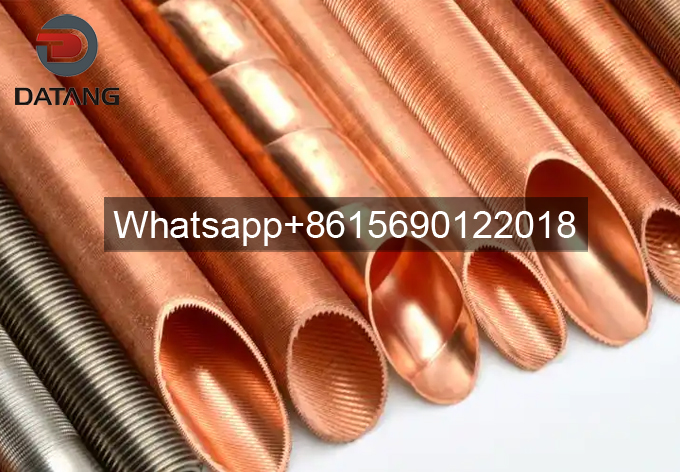
Unlike attached fins (which are welded, wrapped, or crimped onto a base tube), an integral finned tube features fins that are formed directly out of the tube’s parent wall.
Integral finned tubes enhance heat transfer by extending a tube’s surface area, compensating for the poor thermal conductivity of external fluids like air or gas. The fins are machined directly from the base tube, eliminating thermal contact resistance and ensuring highly efficient, continuous heat dissipation or absorption.
The Structural Advantage: Because the tube and the fins are a single, continuous piece of metal, there is zero interfacial thermal resistance between the fin and the tube wall. The fins can never loosen, vibrate apart, or undergo galvanic corrosion at the bond line.
The Heat Transfer Mechanism
- Convection (Fluid-to-Fin): A fluid flows through the inside of the tube, transferring thermal energy through the tube wall.
- Conduction (Through the Metal): Heat conducts radially outwards from the base tube directly into the solid fins.
- Convection & Radiation (Fin-to-Medium): The significantly larger surface area of the fins allows the external medium (e.g., ambient air) to absorb or reject heat much more rapidly through natural or forced convection.
Integral Finned Tubes Working Principle in Action
- Internal Convection & Conduction: The primary hot (or cold) fluid flows through the inner bore of the base tube. Thermal energy is transferred to the tube wall via internal convection and then conducted radially outward through the solid metal wall.
- Seamless Radial Transfer: Due to the monolithic structure, the conducted heat instantly reaches the base of the integral fins without any interfacial loss.
- External Convective Exchange: The heat travels along the fin to its tip. As the external fluid (air, gas, or liquid) is forced or naturally drawn across the fin array, convective heat transfer occurs. The disrupted boundary layer ensures this process is highly efficient.
- Continuous Thermal Equilibrium: The entire system reaches a dynamic thermal equilibrium where heat is continuously extracted from or added to the internal fluid at maximum possible rates.
Key Benefits of Integral Finned Tubes
By utilizing advanced metallurgical processing, Datang Finned Tube delivers products that offer distinct operational advantages:
| Feature | Smooth/Standard Tube | Datang Integral Finned Tube |
| Surface Area per Meter | Baseline (1x) | Up to 200% – 500% higher |
| Thermal Contact Resistance | N/A | Absolute Zero ($0$) |
| Risk of Fin De-bonding | High (in harsh thermal cycles) | None (Monometallic structure) |
| Equipment Footprint | Large / Bulky | Compact & Lightweight |
| Mechanical Strength | Standard | Enhanced resistance to bending/vibration |
Why Choose Datang Finned Tube?
Engineering high-performance thermal systems requires components manufactured to exact tolerances. Datang Finned Tube specializes in the state-of-the-art extrusion and rolling of integral finned tubes across various material grades, including copper, aluminum, carbon steel, and stainless steel alloys.
Our integral finned tubes ensure:
-
Optimal Fin Geometry: Precisely calculated fin pitch, height, and thickness to match your specific fluid dynamics.
-
Long-Term Reliability: Resilient against severe thermal cycling, mechanical vibration, and high-pressure environments.
-
Cost-Efficiency: Maximum heat rejection per dollar spent on raw materials, allowing you to design smaller, more cost-effective shell-and-tube or air-cooled heat exchangers.
