


In refinery and petrochemical plants, air-cooled heat exchangers (ACHEs) operate under demanding thermal, mechanical, and environmental conditions. The selection of finned tubes can affect heat-transfer performance, thermal stability, maintenance requirements, and the long-term operating cost of the air cooler.
Two commonly considered constructions are extruded finned tubes and L-footed finned tubes. They use different fin attachment methods and therefore have different characteristics in terms of mechanical bonding, thermal contact, temperature capability, thermal cycling, maintenance, and initial cost.
When should an extruded aluminum finned tube be selected, and when can an L type finned tube be a practical choice?
There is no universal answer. The appropriate fin construction depends on the tube metal temperature, thermal cycling, air-side environment, corrosion and fouling conditions, mechanical requirements, project specifications, and life-cycle cost.
This guide compares extruded vs. L-footed fin tubes from the perspective of air-cooled heat exchanger design and procurement, with particular attention to refinery and petrochemical applications.
Extruded vs. L-Footed Finned Tube: Quick Comparison
| Parameter | Extruded Bimetallic Finned Tube | L Type Finned Tube(L Foot) |
|---|---|---|
| Fin attachment | Integral bimetallic construction | Tension-wrapped mechanical attachment |
| Manufacturing | Aluminum sleeve mechanically formed around the base tube | Aluminum strip formed into an L-foot and helically wound |
| Fin-to-tube contact | Very strong mechanical contact | Mechanical contact maintained by winding tension |
| Thermal contact resistance | Low | Generally higher than integral construction |
| Fin stability | High | More sensitive to thermal cycling and mechanical conditions |
| Temperature capability* | Commonly used around 280°C depending on materials and design | Commonly used around 150°C for L-type construction |
| Thermal cycling | Well suited to demanding thermal cycling | Requires evaluation where repeated thermal cycling is expected |
| Initial cost | Generally higher | Generally lower |
| Maintenance | Good resistance to fin loosening; cleaning method should be considered | Requires attention to fin condition and attachment |
| Typical use | Demanding heat-transfer and mechanical service | Moderate-temperature and cost-sensitive applications |
NOTED: Temperature values are indicative rather than universal design limits. The allowable operating temperature must be confirmed according to the fin material, base tube material, attachment construction, thermal cycling, corrosion environment, and project specification.
What Is the Difference Between Extruded and L-Footed Finned Tubes?
The main difference is the way the aluminum fin is attached to the base tube.
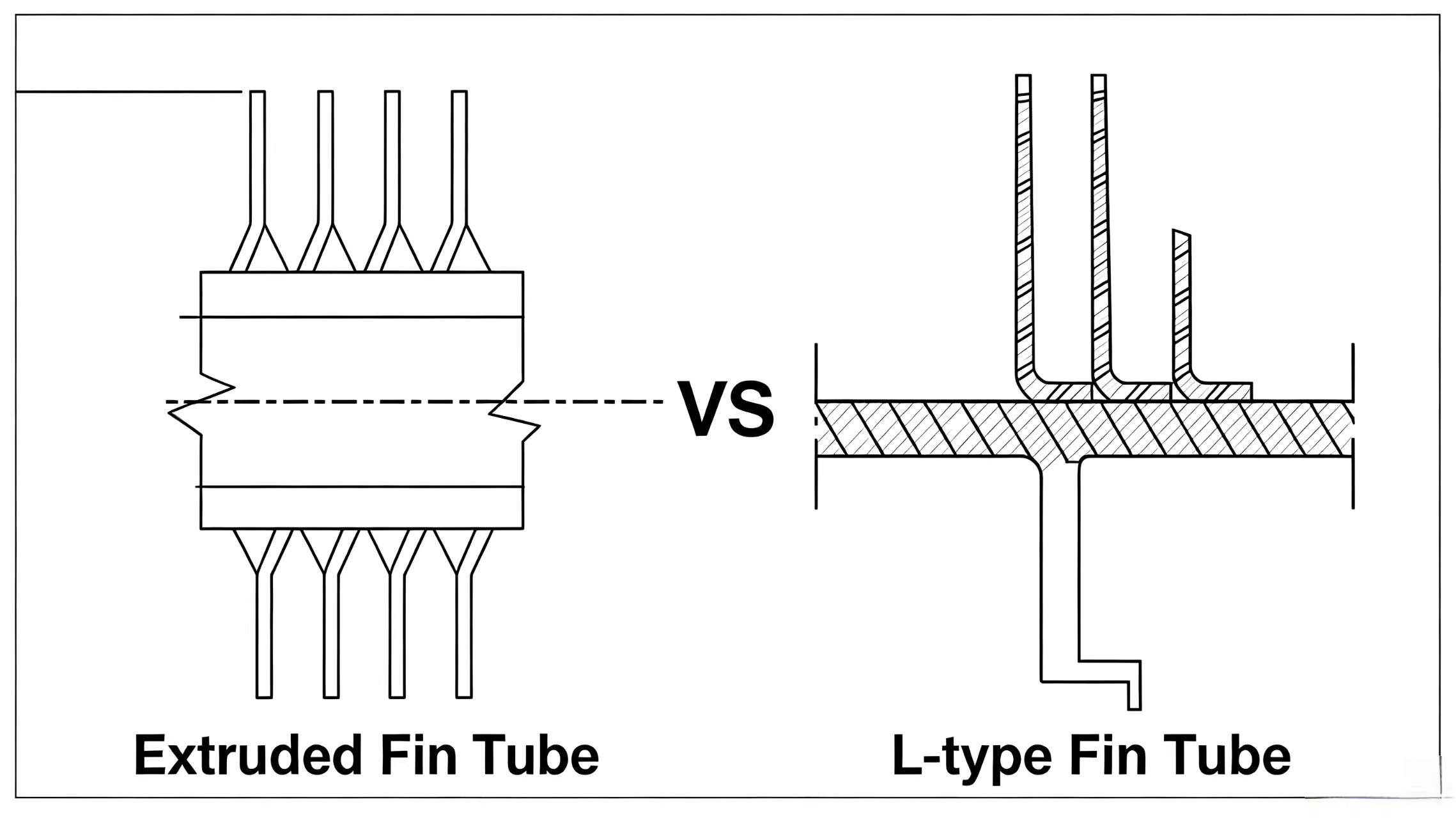
Aluminium Extruded Finned Tubes
An extruded fin tube generally consists of a base tube inserted into an aluminum sleeve. The aluminum outer layer is mechanically formed and rolled or extruded to create the fins.
This process produces an integral bimetallic construction, with a tight mechanical bond between the aluminum fin material and the base tube.
The close contact between the two materials minimizes thermal contact resistance and provides strong fin attachment. This construction is therefore often considered when the air cooler requires greater mechanical stability, repeated thermal cycling, or higher operating temperatures than conventional L-foot construction.
L-Footed Tension Wrapped Finned Tubes
An L-footed finned tube is manufactured by forming an aluminum strip into an L-shaped foot and helically winding the strip around the base tube under controlled tension.
The L-shaped foot provides mechanical contact between the fin strip and the tube surface. This manufacturing method is relatively simple and efficient, which generally results in a lower initial purchase cost.
L-footed finned tubes remain a practical option for many moderate-temperature applications, particularly when the operating conditions are within the applicable range and initial equipment cost is an important consideration.
How Are Extruded and L-Footed Finned Tubes Manufactured?
Understanding the manufacturing process helps explain the differences in fin attachment and service behavior.
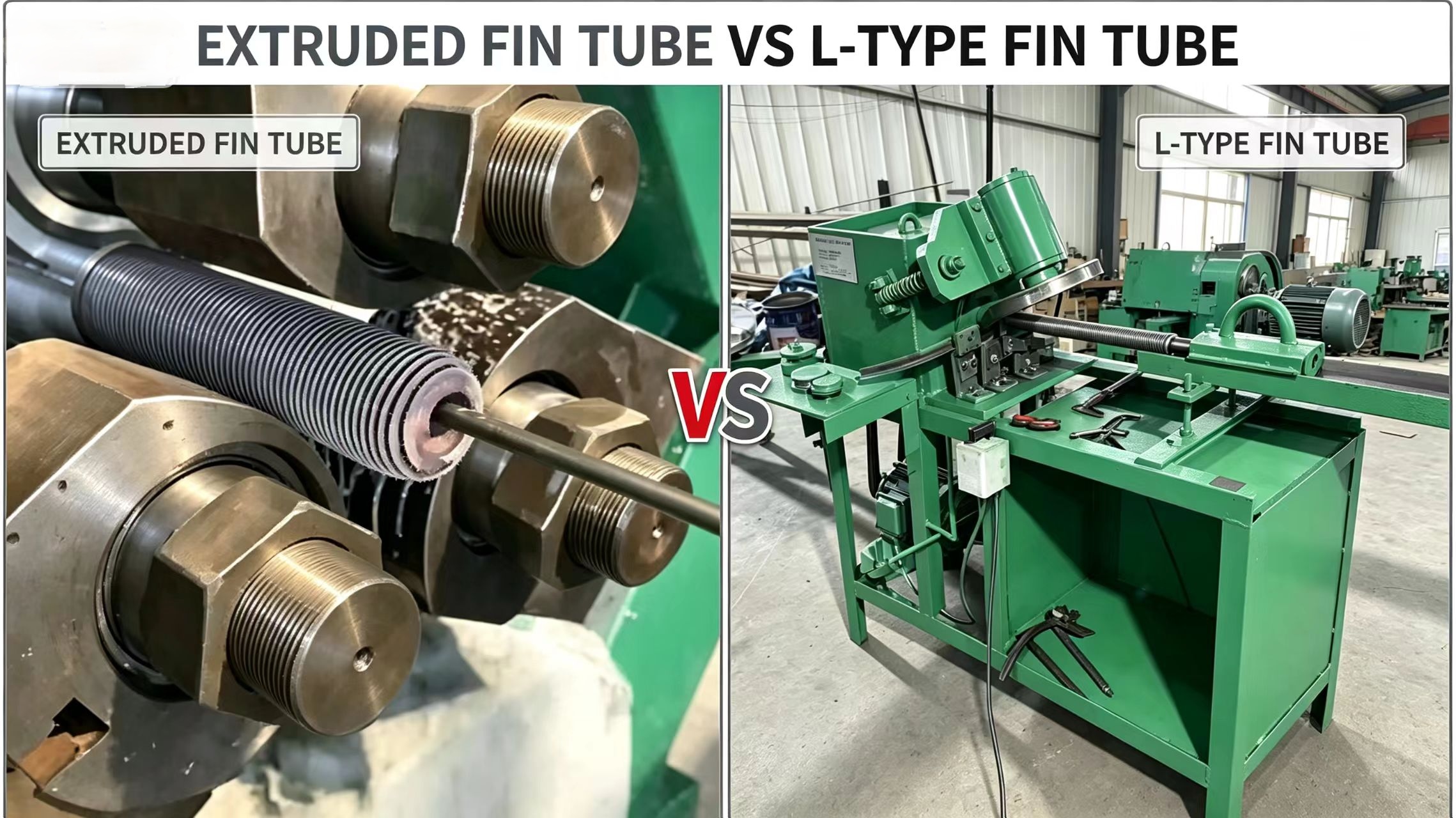
Extruded Finned Tube Manufacturing
A typical manufacturing sequence includes:
- Preparing the base tube and aluminum sleeve.
- Inserting the base tube into the aluminum sleeve.
- Mechanically forming the aluminum sleeve around the tube.
- Forming the aluminum outer layer into the required fin geometry.
- Controlling fin height, fin pitch, fin thickness, and tube dimensions.
- Inspecting the finished finned tube.
Because the aluminum outer layer is mechanically formed around the tube, the finished product has a close and continuous mechanical interface.
L-Footed Finned Tube Manufacturing
A typical process includes:
- Preparing the aluminum fin strip.
- Forming the strip into an L-foot profile.
- Positioning the fin strip against the base tube.
- Helically winding the strip under controlled tension.
- Maintaining the specified fin pitch.
- Inspecting fin attachment, dimensions, and surface condition.
The process requires less specialized tooling than integral extrusion, which is one reason L foot finned tubes are often more economical.
Heat Transfer Performance: Extruded vs. L Foot Finned Tubes
Fin attachment is only one factor affecting the thermal performance of an air-cooled heat exchanger. Fin height, fin pitch, fin thickness, tube diameter, air velocity, fin efficiency, fouling, and bundle design also have significant effects.
However, the thermal interface between the fin and base tube is an important consideration.
Thermal Contact Resistance
In an L-footed finned tube, heat must transfer from the base tube through the mechanical contact interface into the aluminum fin.
The quality of this contact depends on the winding tension, fin geometry, surface condition, thermal expansion, and operating history.
Extruded finned tubes provide a much tighter mechanical interface between the aluminum outer layer and the base tube. This can minimize thermal contact resistance compared with tension-wrapped constructions.
Therefore, when the design places a strong emphasis on stable fin-to-tube contact, an extruded construction may provide an advantage.
Fin Stability
Fin stability is particularly important when the air cooler experiences:
- Repeated startup and shutdown
- Large temperature changes
- Thermal cycling
- Vibration
- Transportation or handling
- Frequent cleaning
Extruded construction provides strong mechanical attachment and high fin rigidity.
L-footed fins rely on the mechanical contact produced by the winding process. Under demanding thermal or mechanical conditions, the attachment should therefore be evaluated carefully.
Heat Transfer Surface
Both constructions can provide a large external heat-transfer area.
However, the overall heat-transfer performance of an ACHE cannot be determined simply by comparing fin types. A proper thermal evaluation should consider the complete tube and bundle design, including:
- Base tube diameter
- Tube wall thickness
- Fin height
- Fin pitch / FPI
- Fin thickness
- Fin material
- Air velocity
- Process-fluid temperature
- Ambient temperature
- Fouling conditions
- Required heat duty
For this reason, selecting a finned tube based only on nominal fin type can lead to an incomplete design decision.
Temperature and Thermal Cycling
Operating temperature is one of the most important factors when comparing extruded and L-footed finned tubes.
Extruded Finned Tubes
Extruded aluminum finned tubes are commonly used in applications with relatively demanding temperature requirements. Depending on the materials and construction, operating temperatures around 280°C are commonly specified for this type of finned tube.
The integral mechanical construction helps maintain close contact between the fin and tube during repeated thermal expansion and contraction.
However, 280°C should not be treated as a universal maximum temperature. The actual allowable temperature depends on:
- Base tube material
- Aluminum alloy
- Fin geometry
- Thermal cycling
- Corrosion conditions
- Design requirements
- Applicable project standards
L-Footed Finned Tubes
L-type finned tubes are commonly used at temperatures around 150°C, while LL-type constructions can be used at somewhat higher temperatures depending on the design and manufacturer.
At elevated temperatures, the difference in thermal expansion between aluminum and the base tube material can affect the contact pressure between the fin and tube.
Repeated thermal cycling can therefore increase the risk of changes in fin attachment and thermal contact resistance.
For applications with high tube metal temperatures or frequent thermal cycling, the fin attachment method should be evaluated as part of the overall thermal and mechanical design.
Why Thermal Expansion Matters
Aluminum and steel have different coefficients of thermal expansion.
When an air cooler repeatedly heats and cools, the aluminum fin and base tube expand and contract at different rates.
For a tension-wrapped fin, these dimensional changes can influence the mechanical contact between the fin foot and tube.
An integral extruded construction provides a stronger mechanical interface and can therefore be advantageous where repeated thermal cycling is an important design condition.
This does not mean that every high-temperature air cooler requires extruded fins. Instead, tube metal temperature and thermal cycling should be evaluated together with the selected fin construction.
Extruded vs. L-Footed Finned Tubes for Refinery and Petrochemical Air Coolers
Refinery and petrochemical air coolers can experience a combination of high process temperatures, large temperature changes, outdoor exposure, dust, humidity, corrosion, vibration, and long operating periods.
Therefore, fin selection should be based on the actual service conditions rather than on fin type alone.
Refinery Air Cooler Applications
Finned tube air coolers may be used for applications such as:
- Process stream cooling
- Hydrocarbon cooling
- Product cooling
- Reflux cooling
- Hot oil cooling
- Compressor aftercooling
- Condensing and cooling duties
For these applications, the designer may need to evaluate tube metal temperature, thermal cycling, air-side fouling, corrosion, mechanical stability, and cleaning requirements.
Where the service is relatively moderate and the L-foot construction falls within the project requirements, L-footed finned tubes may provide an economical solution.
Where stronger fin attachment, higher temperature capability, or greater thermal-cycling resistance is required, extruded construction may be considered.
Petrochemical Air Cooler Applications
Petrochemical plants often require continuous and reliable heat removal from process fluids and gases.
Depending on the process, air coolers may operate with:
- High process-fluid temperatures
- High ambient temperatures
- Dusty outdoor environments
- Humid or coastal conditions
- Frequent load changes
- Long continuous operating periods
In such applications, the fin construction should be selected together with the complete ACHE thermal and mechanical design.
Key Factors for Selecting Finned Tubes for Air Coolers
When comparing extruded and L-footed finned tubes, the following factors should be evaluated.
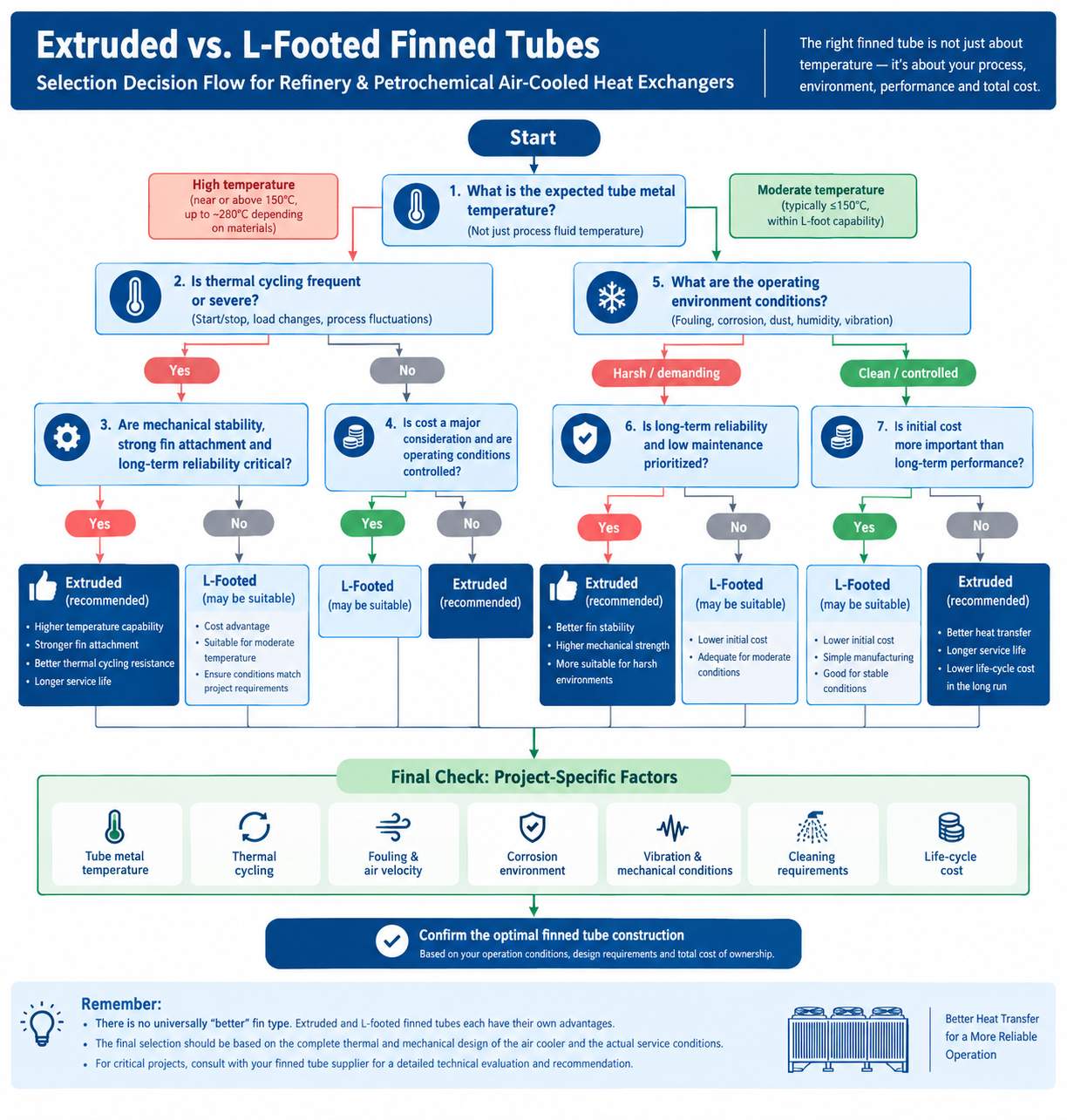
1. Tube Metal Temperature
The calculated tube metal temperature is more relevant than process-fluid temperature alone.
A finned tube may see different temperatures depending on the process-fluid temperature, heat-transfer coefficient, air temperature, and heat duty.
If the tube metal temperature approaches the applicable range of L-foot construction, an extruded construction may be considered.
2. Thermal Cycling
Consider how frequently the air cooler will experience:
- Startup
- Shutdown
- Load changes
- Process fluctuations
- Emergency operation
Frequent thermal cycling increases the importance of fin attachment stability.
3. Air-Side Fouling
Dust and airborne contaminants can accumulate between fins and reduce air-side heat transfer.
When selecting the fin type, consider:
- Fin pitch
- Air velocity
- Fouling tendency
- Cleaning method
- Accessibility
A fin type should not be selected solely because it has a larger nominal surface area.
4. Corrosion Environment
External corrosion conditions can vary significantly between different plants.
Examples include:
- Coastal refinery environments
- High-humidity locations
- Industrial atmospheres
- Salt-laden air
- Corrosive process environments
Fin material, base tube material, surface protection, and fin attachment should be evaluated together.
5. Vibration and Mechanical Conditions
Air coolers contain rotating equipment, including fans and motors, so vibration can be an important consideration.
The complete system should be evaluated for:
- Fan-induced vibration
- Bundle vibration
- Thermal expansion
- Transportation and handling
- Cleaning forces
Where stronger mechanical fin attachment is required, an integral extruded construction may be considered.
6. Cleaning Requirements
The selected fin construction should be compatible with the planned maintenance method.
Depending on the project, cleaning may include:
- Air blowing
- Water washing
- High-pressure water cleaning
- Other mechanical or chemical cleaning methods
The fin geometry, material, and attachment should all be considered when determining cleaning suitability.
Maintenance and Service Life
Maintenance requirements depend heavily on the operating environment and the quality of the original design.
Extruded Finned Tubes
The integral construction provides strong fin attachment and reduces the risk of fin loosening caused by mechanical contact changes.
The relatively robust fin structure can also be advantageous when regular cleaning is required.
However, service life is still affected by corrosion, fouling, thermal cycling, cleaning practices, operating temperature, and material selection.
L-Footed Finned Tubes
L-footed finned tubes can provide reliable service when operated within their appropriate temperature and environmental range.
However, the fin attachment should be monitored in applications involving significant thermal cycling, elevated temperature, vibration, or aggressive cleaning.
During inspection, attention should be given to:
- Loose fins
- Damaged fins
- Corrosion
- Fouling
- Fin deformation
- Changes in heat-transfer performance
Service life should therefore be evaluated on a project-specific basis rather than using a fixed number of years as a universal expectation.
Initial Cost vs. Life-Cycle Cost
Cost is an important consideration for both equipment manufacturers and project procurement teams.
Extruded Finned Tube Cost
Extruded finned tubes generally have a higher initial cost because their manufacturing process requires specialized equipment, tooling, and a more complex bimetallic construction.
However, the purchase price is only one part of the total cost of an air cooler.
L-Footed Finned Tube Cost
L-footed finned tubes generally have a lower initial cost because the manufacturing process is relatively simple and highly efficient.
For moderate-temperature applications with controlled operating conditions, this can make L-footed construction economically attractive.
Consider Total Cost of Ownership
For long-term refinery and petrochemical service, procurement teams should consider:
- Initial purchase price
- Heat-transfer performance
- Fan power requirements
- Cleaning frequency
- Maintenance
- Fin replacement
- Tube replacement
- Production downtime
- Expected operating life
Therefore:
The lowest initial purchase price is not necessarily the lowest total cost over the operating life of an air cooler.
The appropriate comparison is the life-cycle cost, based on the actual project conditions.
When Should You Choose Extruded Finned Tubes?
Extruded construction may be considered when the project has one or more of the following requirements:
- Relatively high tube metal temperature
- Frequent thermal cycling
- Strong fin attachment
- Higher mechanical stability
- Demanding outdoor operating conditions
- Long-term stable fin-to-tube contact
- Greater emphasis on service reliability and life-cycle cost
For refinery and petrochemical ACHEs, the final decision should be confirmed through the thermal and mechanical design rather than based on temperature alone.
When Should You Choose L-Footed Finned Tubes?
L-footed construction may be considered when:
- Operating temperature is within the applicable range
- Thermal cycling is moderate
- The environment is relatively controlled
- Initial purchase cost is an important consideration
- The project specification permits tension-wrapped fin construction
- The required heat-transfer duty can be achieved with the selected fin geometry
L-footed finned tubes remain a widely used and practical solution for many moderate-temperature heat-transfer applications.
Extruded vs. L-Footed Finned Tube: Selection Guide
| Project Condition | Selection Consideration |
|---|---|
| Moderate operating temperature | L-foot may be considered |
| Higher tube metal temperature | Evaluate extruded or other suitable fin constructions |
| Frequent thermal cycling | Extruded may be preferred |
| Strong mechanical attachment required | Extruded may be preferred |
| Cost-sensitive project | L-foot may provide a lower initial cost |
| High fouling environment | Evaluate fin pitch, air velocity, cleaning and fin type together |
| Corrosive environment | Evaluate tube/fin materials and protection together |
| Long-term reliability is important | Compare life-cycle performance and maintenance requirements |
| Refinery or petrochemical ACHE | Select based on thermal, mechanical and project specifications |
The table should be treated as a selection framework, not a substitute for detailed ACHE thermal design.
Case Study
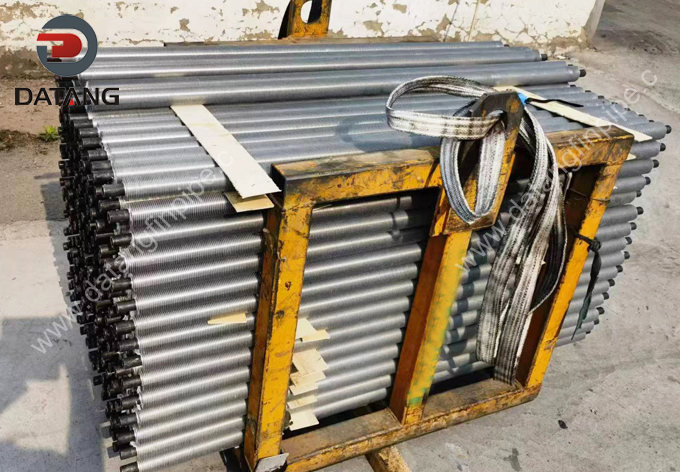
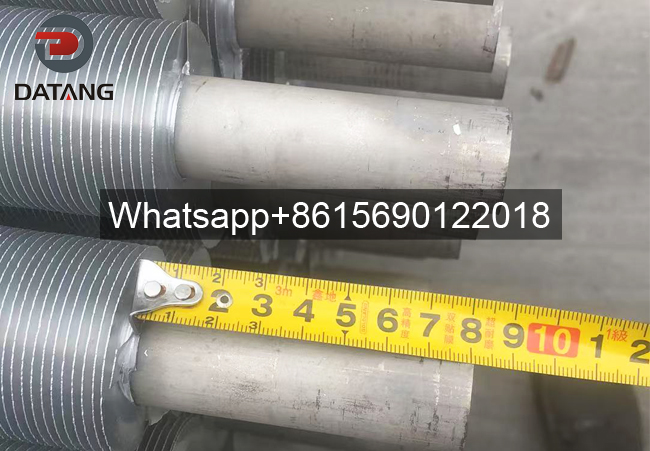
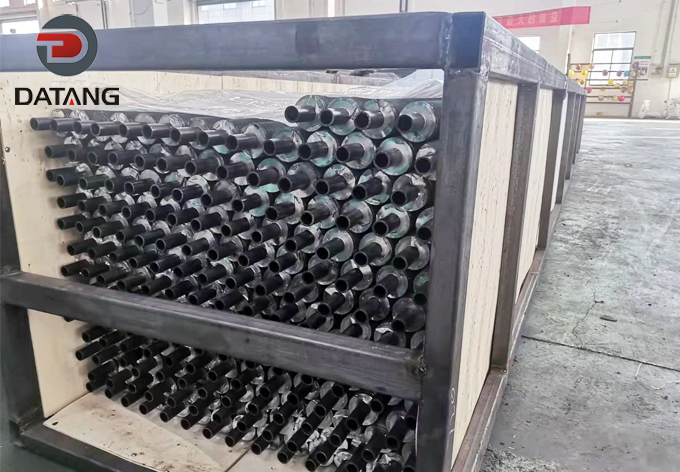
What Information Is Needed to Select a Finned Tube?
If you are purchasing replacement finned tubes or specifying finned tubes for a new air-cooled heat exchanger, the following information can help determine the appropriate construction:
- Base tube outside diameter
- Base tube wall thickness
- Base tube material
- Fin material
- Fin height
- Fin pitch / FPI
- Fin thickness
- Tube length
- Plain tube length
- Process fluid
- Process inlet and outlet temperatures
- Tube metal temperature, if available
- Design pressure
- Design temperature
- Ambient air temperature
- Air-side fouling conditions
- Required heat duty
- Air cooler type
- Quantity required
- Applicable project standards and specifications
For replacement projects, existing tube drawings, photographs, samples, or previous purchase specifications can also help verify the required construction.
FAQ: Extruded vs. L-Footed Finned Tubes
Which type of finned tube is more efficient for heat transfer?
Determining which finned tube is “more efficient” in terms of heat transfer depends largely on your operating temperature and application environment. However, efficiency is primarily determined by how effectively thermal contact resistance—the ease with which heat transfers from the inner tube to the fin—is minimized.
Based on the method of fin attachment, the finned tubes offering the best heat transfer efficiency are:
1. Extruded finned tubes (best suited for moderate temperatures and air coolers)
2. High-frequency welded (HFW) finned tubes (best suited for high temperatures and heavy industrial environments)
3. Mechanically bonded types (L-foot, G-embedded, tension-wound): Standard L-foot or tension-wound finned tubes are more economical to manufacture, but they rely on mechanical tension or winding for attachment.
Is an extruded finned tube better than an L-footed finned tube?
Neither construction is universally better. The appropriate choice depends on operating temperature, thermal cycling, fouling, corrosion, mechanical conditions, cleaning requirements, project specifications, and cost.
What is the typical temperature of an L-footed finned tube?
L-type finned tubes are commonly specified for operating temperatures around 150°C. The actual allowable temperature should be confirmed according to the fin material, base tube material, construction, thermal cycling, and project requirements.
What is the typical temperature capability of an extruded finned tube?
Extruded aluminum finned tubes are commonly used around 280°C in suitable material and construction combinations. This is an indicative value rather than a universal maximum operating temperature.
Are L-footed finned tubes suitable for refinery air coolers?
They can be suitable for refinery air coolers when the operating temperature, thermal cycling, corrosion environment, mechanical requirements, and project specifications are compatible with the L-foot construction.
Are extruded finned tubes suitable for petrochemical air coolers?
Yes. Extruded finned tubes can be considered for petrochemical air coolers where stronger fin attachment, higher temperature capability, thermal cycling resistance, or long-term mechanical stability is required.
Are extruded finned tubes more expensive?
They generally have a higher initial purchase cost because of their manufacturing process and tooling requirements. However, life-cycle cost should also be considered when comparing different fin constructions.
Can L-footed finned tubes be replaced with extruded finned tubes?
Potentially, but replacement should not be based on fin type alone. Tube dimensions, fin dimensions, material, heat-transfer duty, pressure drop, tube metal temperature, bundle geometry, and project requirements should be checked before replacement.
What information should I provide when requesting a finned tube quotation?
Provide the base tube OD and wall thickness, tube material, fin material, fin height, fin pitch/FPI, fin thickness, tube length, plain-end dimensions, operating temperature, process fluid, design pressure, heat duty, quantity, and applicable standards or drawings.
Conclusion
The choice between extruded vs. L-footed finned tubes for an air-cooled heat exchanger should be based on the complete operating and economic requirements of the project.
Extruded finned tubes provide an integral bimetallic construction with strong mechanical attachment and low thermal contact resistance. They may be considered for applications involving higher tube metal temperatures, frequent thermal cycling, demanding mechanical conditions, or a stronger emphasis on long-term fin stability.
L-footed finned tubes offer a simpler and generally more economical manufacturing solution. They can be a practical choice for moderate-temperature, cost-sensitive air cooler applications when the operating conditions and project specifications are suitable.
For refinery and petrochemical ACHEs, the most appropriate fin construction should be determined by evaluating thermal performance, tube metal temperature, thermal cycling, corrosion, fouling, mechanical conditions, maintenance requirements, and life-cycle cost together.
Need Help Selecting Finned Tubes for Your Air Cooler?
Datang manufactures extruded, L/LL/KL, G-type and other finned tube constructions for industrial heat exchangers and air-cooled heat exchangers.
For a project-specific recommendation, provide your tube and fin specifications, operating conditions, drawings or existing tube samples. Our technical team can evaluate the appropriate fin construction based on your application requirements.
Request a Finned Tube Quote →
