


Finned tube heat exchangers are critical equipment for heat transfer in industrial applications. Whether cooling high-temperature gases, recovering waste heat, or maintaining process temperatures, highly efficient heat exchangers are used to reduce energy consumption. What makes finned tube heat exchangers unique is their use of finned tubes, which enhance heat transfer efficiency by increasing the surface area.
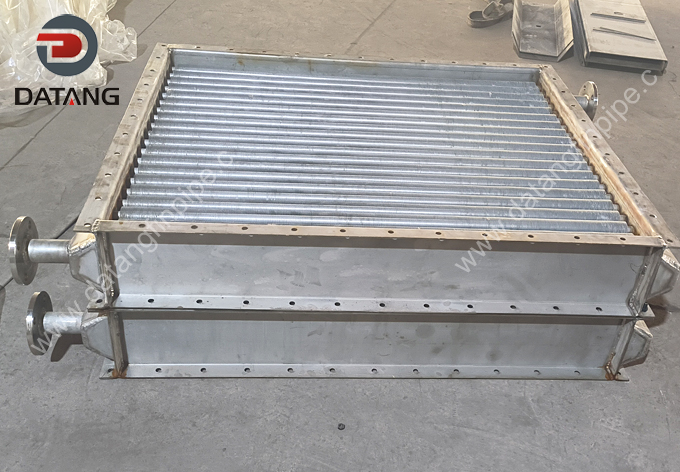
What Is a Fin Tube Heat Exchanger?
A finned tube heat exchanger (also known as an air-cooled heat exchanger) is a device that significantly enhances heat transfer efficiency by adding fins to the outer surface of a base tube, thereby increasing the heat transfer area.
How Fin Tube Heat Exchangers Work?
Fins are used to extend the heat transfer surface area, balancing the disparity in heat exchange capabilities between the fluids on either side and enhancing the overall heat transfer coefficient; the design is compact and offers high heat transfer capacity per unit volume.
Air or gas typically has a much lower thermal conductivity than water, refrigerant, or steam flowing inside the tubes. If bare tubes are used directly, the air-side heat transfer efficiency becomes the bottleneck of the entire system.
-
Expanding heat transfer surface area: Adding metal fins to the outer walls of the tubes increases the surface area in contact with air by several times to tens of times.
-
Enhancing fluid turbulence: As gas flows through dense, complex fin structures, it generates strong turbulence that breaks the static boundary layer along the tube walls, further accelerating heat transfer.
For example:
- Fluid inside the tube (water, steam, thermal oil, or refrigerant)
- Fluid outside the tube (typically air or gas)
- Result: Heat exchange process
Components of a finned tube heat exchanger:
Base tube
A conduit for fluid flow within the pipe. It withstands internal system pressure and serves as the primary medium for heat transfer.
- Round / Oval / Flat tube
- Base tube materials: Carbon steel, stainless steel, copper.
Fins
Multiply the heat transfer surface area on the outside of the tube (gas side) while disturbing the airflow to enhance heat transfer efficiency.
- Fins: Helical (Spiral) / Longitudinal / Corrugated / Serrated.
- Fin materials: Aluminum, steel, copper, or bimetallic (Steel-aluminum).
Tube Sheet
- Heavy metal plate with patterned openings.
- Fixes both ends of the base tubes, ensuring uniform tube spacing and separating the fluid inside the tubes from the gas outside.
Frame & Side Plates
- Protect the internal tube bundle from mechanical damage.
- Bear the structural weight and installation load of the entire unit.
Header / Water Chamber
- Chambers connected at both ends of the tube bundle.
- Which uniformly distribute the inlet fluid into individual base tubes, or collect and discharge the fluid after heat transfer.
Why Use Finned Tube Heat Exchangers?
- High Heat Transfer Efficiency: Increases the heat transfer surface area by several to dozens of times compared to conventional bare tubes.
- Compact Design & Space Savings: Delivers higher thermal loads within limited spatial footprints.
- Pressure & Corrosion Resistance: Suitable for high-temperature, high-pressure, or harsh industrial environments.
- Energy Savings & Cost Efficiency: Reduces fan power consumption and extends overall equipment service life.
Types of Finned Tubes Used
The heat transfer performance of finned tube heat exchangers largely depends on the fin design. A variety of fin structures are available to suit different operating conditions.
Extruded Fin Tubes
- High heat transfer
- Strong corrosion resistance
- Commonly uses bimetallic materials, steel tubes + aluminum fins
High-Frequency Welded (HFW) Fin Tubes
- High strength
- High-temperature resistance
- High-pressure resistance
- Boiler + economizer
Embedded / G-Type Fin Tubes
- High temperature resistance (up to over 400°C)
- Resistance to wind erosion
- Used in air coolers
Tension Wound (L/KL/LL-Type) Fin Tubes
- Economical
- Excellent corrosion resistance
Laser Welded Fin Tubes
- Extremely small weld seams
- High heat transfer efficiency
- Demanding operating conditions
H-Type / Double H-Type Fin Tubes
- Good self-cleaning properties
- Resistant to dust accumulation
- Used for exhaust gas waste heat recovery
Fin Tube Heat Exchangers Industrial Applications
Petrochemical & Oil & Gas
- Refinery air coolers.
Power & Energy
- Power plant economizers
- Waste heat recovery boilers (WHRB).
HVAC & Refrigeration
- Large-scale central air conditioning condensers
- Evaporators
- Drying equipment
Food & Agriculture:
- Material drying systems (drying of timber, grain, and agricultural products)
Finned Tube Heat Exchanger Selection Guide and Custom Specifications
Base Tube
- Carbon steel
- Stainless steel
- Copper
- Titanium
Fins
- Aluminum
- Copper
- Carbon steel
Key Dimensional Parameters
- Tube Outer Diameter (OD)
- Wall Thickness (WT)
- Fin Height
- Fin Thickness
- Fin Pitch (FPI)
Operating Conditions
- Operating temperature
- Operating pressure
- Fluid type (corrosivity/viscosity)
Fin Tube Heat Exchanger vs Plain Tube Heat Exchanger
| Feature | Fin Tube Heat Exchanger | Plain Tube Heat Exchanger |
| Surface Area | High | Lower |
| Heat Transfer Rate | Higher | Lower |
| Equipment Size | More Compact | Larger |
| Air Cooling Efficiency | Excellent | Moderate |
| Initial Cost | Higher | Lower |
| Energy Efficiency | Better | Lower |
Quality Control & Standards
Inspection & Testing:
- Pressure / Leak Testing: Hydrostatic Test / Pneumatic Test
Verify the pressure-bearing limits and sealing performance of the base pipe and welds under design pressure.
- Eddy Current Testing (ECT): Eddy current non-destructive testing
Detect minute defects, cracks, corrosion pits, or wall thickness irregularities within the wall and on the surface of the base tube.
- Pull-off / Fin Bonding Test: Fin-to-tube pull-off test
Measure the mechanical bond strength between the fin and the base tube to ensure the fin is securely attached.
- Metallographic Analysis: Microstructural examination
Observe the metal’s grain structure, heat-affected zone (HAZ), and weld microstructure under a microscope.
Compliance with International Standards:
- ASTM
- ASME
- EN
- DIN
- ISO
Why Choose Datang Finned Tube Heat Exchangers?
Full Customization Across Manufacturing Processes
- Supports diverse fabrication methods, including High-Frequency Welding (HFW), bimetallic extrusion, G-type/L-type tension winding, and laser welding.
- Accommodates multi-material combinations (carbon steel, stainless steel, copper, aluminum, etc.) to precisely match various operating conditions.
High Efficiency & Durability
- Tight bond between fins and base tubes
- Low contact thermal resistance
Rigid Quality Control
- Rigorous pre-delivery testing, including hydrostatic, airtightness
- non-destructive testing;
- Guarantees zero leakage in high-pressure environments.
Premium Packaging Materials
- High-standard anti-rust treatment;
- High-strength packaging (steel-framed wooden crates);
- Ensures products arrive intact after long-distance transport.
Extensive Overseas Experience
- Familiarity with international standards (e.g., ASME, ASTM);
- Rapid response capabilities;
- Efficient delivery of diverse industrial waste heat recovery and air cooler projects.
Conclusion
Finned heat exchangers are among the most efficient solutions for heat transfer between fluids, particularly when air or gases are involved. By utilizing fins to increase the heat transfer surface area, these exchangers enhance thermal efficiency, reduce energy consumption, and allow for more compact system designs.
With proper design, appropriate material selection, and regular maintenance, these heat exchangers deliver reliable and cost-effective performance across a wide range of industrial applications.
Whether you are designing HVAC systems, industrial machinery, or power generation equipment, finned-tube heat exchangers provide the performance and reliability needed for long-term success.
Get a Customized Quote and Technical Support
Please provide your operating parameters or drawing specifications. Our engineering team will evaluate your requirements and provide detailed thermal calculation results along with a highly competitive quote within 24 hours.
