


Internally threaded tubes are products applied in dry expansion evaporators.
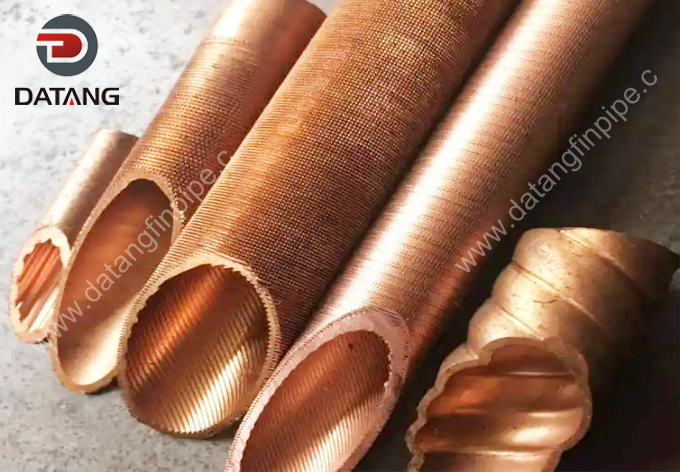
An internally threaded tube (also known as a dry evaporation tube, internally ribbed tube, or internally finned tube) is a high-efficiency heat exchange element used in central air-conditioning dry expansion evaporators, as well as in refrigeration and air conditioning, heat exchangers, and computer radiators.
The inner wall of an internally threaded tube is provided with a spiraling rectangular groove structure. By enhancing fluid turbulence and centrifugal force, it maintains a water film on the tube wall, avoids film boiling, and increases the convective heat transfer coefficient. Its internal surface area reaches 1.5 to 2 times that of smooth copper tubes, the heat transfer coefficient is increased to 1.5 to 2.4 times, and the flow resistance increases by only 3% to 5%.
Manufacturing Process of Internally Threaded Tubes
The production of internally threaded tubes includes drawing methods and welding methods:
-
Welding method: Formed by thread rolling and high-frequency welding using TP2 copper strip.
-
Drawing method: Achieves helical tooth formation through planetary roller spinning or planetary ball die spinning.
The material of internally threaded tubes is mainly TP2 copper, and specifications such as outer diameters of 7–16 mm can be customized, complying with GB/T1527 and GB/T20928 standards. This technology can reduce the energy consumption of air conditioning systems by 20–35% and reduce the total unit weight by 10–25%.
Working Principle of Internally Threaded Tubes
During the heat-induced evaporation process of the working medium inside the tube, as the heat load increases, the operating condition—which was originally nucleate boiling—transforms into film boiling because water cannot be replenished to the wall surface in time. At this point, the wall surface comes into contact with the vapor film, the heat transfer coefficient drops sharply, and the tube wall temperature rises rapidly due to the lack of good cooling, causing overheating and burn-out of the heating surface.
The key to preventing heat transfer deterioration caused by film boiling is to ensure that the water in the annular water film on the inner wall of the tube can be replenished in time, and the source of water is the water droplets in the central vapor stream.
Methods for water droplets in the central vapor stream to deposit onto the water film:
-
Utilize the inertial force of the water droplets themselves. This requires increasing the turbulence of the vapor stream, which is usually achieved by increasing the fluid flow velocity, leading to an increase in flow passage resistance.
-
Utilize centrifugal force to make the water droplets reach the tube wall under conditions where the flow velocity is not high. Internally threaded tubes adopt the latter method.
When the working medium flows inside the internally threaded pipe, it generates rotation under the action of the spiraling internal threads. The water droplets in the vapor stream continuously move closer to the tube wall under the action of centrifugal force and finally reach the tube wall, allowing the water film to be replenished.
The water film in the rectangular grooves of the internal threads is also not easily carried away by the vapor stream due to the three-dimensional adhesion force, allowing the water film to be sustained continuously without being dried out immediately.
On the other hand, the internal threads also increase the turbulence of the fluid inside the tube, improving the convective heat transfer coefficient, thereby strengthening heat transfer and allowing the tube wall to be better cooled.
Internally Threaded Pipe Welding Method
The welding method is a process in which threads are directly rolled onto a copper strip, which is then welded into a tube.
The production process flow for welded internally threaded tubes is as follows: High-precision copper strip → Thread rolling → Forming and welding → Sizing → Finishing coiling → Annealing → Packaging.
The main raw material for welded tubes is TP2 copper strip. During production, the head and tail of the copper strips are welded together to ensure continuous line operation. The copper strip first passes through the thread rolling process; depending on the thread profile, a different number of embossing rollers are selected.
After rolling the threads, the copper strip is shaped through several passes of forming rollers and then undergoes high-frequency welding. To ensure uniform diameter and dimensions, a scraper is first used after welding to remove external burrs, and the tube then passes through sizing rollers for sizing to ensure that the outer diameter and ovality of the pipe conform to technical requirements.
Key Process in Internally Threaded Metal Tube Production
The forming process of internally threaded metal tubes made by the welding method is shown in Figure 1 below.
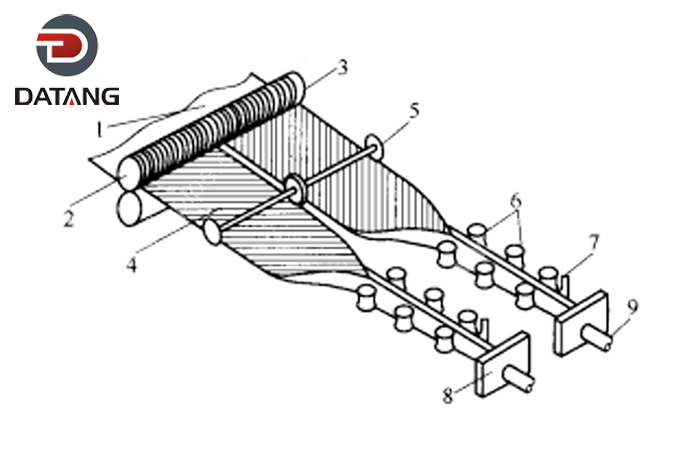
In the production process of internally threaded welded copper tubes, the two most critical processes are thread rolling and welding.
-
Thread rolling. The design and manufacturing of the embossing rollers are the core technology of welding forming. Unscientifically designed embossing rollers will lead to uneven deformation of the copper strip, causing periodic welding defects while shortening the service life of the rollers.
-
High-frequency welding. The line speed of high-frequency welding is extremely fast, generally averaging around 150 m/min. Such a fast processing speed places higher demands on the precision of the squeezing and guiding rollers.
In the world’s copper tubes used in the air conditioning and refrigeration industry, the proportion accounted for by welded tubes is still very small. In addition to traditional cognitive barriers regarding welded tubes, one of the important reasons restricting the promotion of welded tubes is the higher cost of raw materials (copper strips). At the same time, because this process has high technical difficulty, it is still in the development stage.
Processing Internally Threaded Tubings by Drawing Method
Internally threaded copper tubings produced by the drawing method are seamless internally threaded copper tubes. Seamless internally threaded copper tubes are heat transfer tubes commonly used in the air conditioning and refrigeration industry.
Processing methods for the drawing method of internally threaded tubes: One is the extrusion-drawing method, and the other is the spinning-drawing method.
Extrusion-Drawing Method of Internally Threaded Tubes
The extrusion-drawing method is similar to the plug-drawing method for smooth tubes. During the drawing process, due to the action of forces, the threaded mandrel produces a rotational motion within the deformation zone, while the tube does not rotate and only makes axial linear motion. Under the action of the outer drawing die and the threaded mandrel, the inner wall of the tube is forced to squeeze out helical ribs, thereby forming an internally threaded tube, as shown in Figure 2 below.
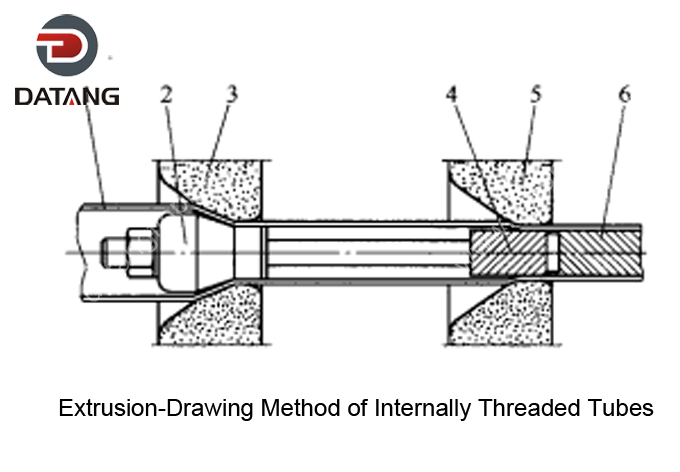
Although this method uses a simple apparatus, it is not easy to achieve the ideal depth for the thread grooves. This is because, during the extrusion-forming process, the material flows easily in the axial direction along which it is drawn, but flows with difficulty in the radial direction of tooth formation. Furthermore, the thread-forming area is subjected to sliding friction, high stress, and high temperatures, making it even more difficult to process small-diameter, thin-walled internally threaded tubes.
Spinning-Drawing Method of Internally Threaded Tubes
There are two modes for the spinning-drawing method:
-
Planetary roller spinning
-
Planetary ball die spinning
Processing Principle of the Spinning-Drawing Method for Internally Threaded Tubes
The spinning-drawing method uses several planetarily rotating rollers or balls to perform high-speed spinning on the outer surface of the tube, causing the material to undergo plastic deformation. Consequently, the helical teeth on the threaded mandrel are mirrored onto the inner surface of the tube, forming threads on the internal surface.
Compared with the extrusion-drawing method, this method not only converts sliding friction into rolling friction, reducing the thread-forming stress, but can also process deeper thread grooves. Furthermore, after being processed by spinning, the mechanical properties of the tube are significantly improved.
Application of Internally Threaded Tubes
Internally finned tubings are mainly applied in dry expansion evaporators in central air conditioners; during heat exchange, the outside of the tube is cooled by the refrigerant evaporating and expanding inside the tube.
They are also applied in household and commercial air conditioner heat exchangers, or used in high-heat-flux heat pipes.
The internal surface area per unit length of an internally threaded tube is 1.5 to 2 times that of a ordinary smooth copper tube, and its heat transfer coefficient is 1.5 to 2.4 times that of a smooth copper tube of the same specification. Meanwhile, the flow resistance to the carrier medium increases by only 3% to 5%, which can save energy by 20% to 35% and reduce the overall weight of the refrigeration and air-conditioning unit by 10% to 25%.
Why choose Datang as a partner?
Choosing Datang Finned Tube’s internally threaded tubes helps downstream customers (such as air conditioner OEMs, heat exchanger manufacturers, and system integrators) eliminate the following major headaches:
-
Eliminates Bulky Equipment and Difficult Transportation/Installation
-
Pain Point Solved: A 1.5–2.4x increase in heat transfer efficiency substantially reduces the total amount of piping required for the same heat exchange capacity.
-
Direct Benefit: Allows for smaller evaporators/heat exchangers and cuts total unit weight by 10%–25%, saving on expensive shipping, rigging, and footprint costs.
-
-
Eliminates High System Energy Consumption and End-User Complaints
-
Pain Point Solved: Standard smooth tubes feature low heat transfer efficiency, keeping energy consumption high and making it difficult to meet stringent energy efficiency standards.
-
Direct Benefit: Strong convective heat dissipation capabilities reduce overall system energy consumption by 20%–35%, helping customers effortlessly meet efficiency standards while avoiding end-user complaints or returns.
-
-
Eliminates Dry-Burning Damage and Frequent Equipment Downtime
-
Pain Point Solved: Under high heat loads in dry expansion evaporators, traditional tubes are prone to “film boiling” (the liquid film dries out, causing tube wall temperatures to spike and burn out the heating surface).
-
Direct Benefit: Datang Finned Tube’s helical grooves generate centrifugal force and three-dimensional adhesion that continuously replenish the liquid film even at low flow velocities. This prevents film boiling, extends equipment service life, and saves you from frequent maintenance downtime.
-
-
Eliminates Excessive Pump Power Loss and Hydraulic Imbalance
-
Pain Point Solved: Conventional heat transfer enhancement techniques often sharply increase fluid resistance, forcing the selection of larger pumps or blowers.
-
Direct Benefit: While doubling the heat transfer coefficient, fluid resistance increases by a minimal 3%–5%. Customers can avoid reconfiguring higher-power circulating pumps or dealing with complex system resistance matching.
-
-
Eliminates Processing Limitations and Unstable Manufacturing Quality
-
Pain Point Solved: Dry expansion evaporators demand strict, diverse specifications for copper tubing (outer diameters of 7–16 mm) and standards (such as GB/T1527 and GB/T20928).
-
Direct Benefit: Supported by high-precision welding and spinning-drawing processes, Datang Finned Tube offers flexible customization and consistent quality, eliminating risks of tube bursting or leakage during secondary processing (like bending and expanding).
-
