


When selecting finned tubes for air cooled heat exchangers (ACHEs), condensers, or industrial radiators, the choice between Embedded (G-Type) and Extruded fin tubes is one of the most critical decisions.
The fundamental difference lies in how the fin is attached to the base tube. which directly dictates their applicable scenarios, temperature tolerance, corrosion resistance, and overall operating costs.
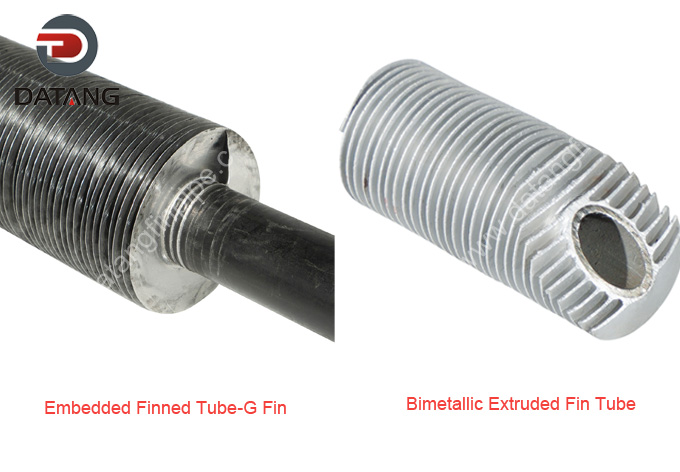
Differences in Manufacturing Processes
Embedded Finned Tubes (G-Type): The process begins by mechanically cutting a helical groove (usually 0.4 mm to 0.5 mm deep) into the outer wall of the base tube. An aluminum or copper fin strip is then wound into the groove under continuous tension. To complete the process, the groove is rolled closed, firmly locking the fin root inside the tube.
Connection Strength: The stability of this connection is maintained solely by the mechanical tension of the locked grooves, ensuring a secure and reliable fit.
Extruded Finned Tubes: This process utilizes a bimetallic structure, most commonly steel-aluminum composite extruded finned tubes. First, a thick-walled aluminum sleeve is fitted over the inner core tube (such as carbon steel or stainless steel). Subsequently, the entire assembly is passed through a three-spindle rolling device equipped with rollers. These rollers extrude the aluminum material, forcing it to extend outward and form continuous, helical cooling fins.
This bonding method creates a 100% sealed mechanical connection. The inner tube is completely encapsulated by the outer aluminum shell, ensuring that no base metal is exposed to the external environment.
Technical Comparison Matrix
| Comparison Dimension | Embedded Finned Tube | Extruded Finned Tube |
|
Bonding Method |
Mechanical grooving, wound embedding, and roller locking. |
Bimetallic sleeve, integral cold extrusion molding. |
|
Max. Operating Temperature |
Higher (up to 400°C / 752°F). |
Moderate (typically 250°C – 300°C / 482°F – 572°F). |
|
Contact Thermal Resistance |
Low initially, but may increase after long-term cyclic thermal conditions. |
Virtually zero, offering extremely high heat transfer efficiency. |
|
Corrosion Resistance |
Base tube is exposed; standard/moderate corrosion resistance. |
Aluminum fins completely encapsulate the base tube; excellent corrosion resistance. |
|
Manufacturing Cost |
Relatively lower. |
Relatively higher. |
Core features and advantages:
Temperature Resistance
Embedded (G-Type) Finned Tube:High Temperature Resistance: Due to the mechanical locking structure, embedded finned tubes can withstand elevated temperatures, with a maximum operating temperature typically up to 400°C (752°F), and they perform well under cyclic thermal conditions (heating and cooling cycles). The maximum operating pressure is 32 MPa.
Extruded Finned Tube:Limited by the physical properties of the outer aluminum material, the maximum operating temperature of extruded finned tubes is up to 300°C (572°F), making them unsuitable for ultra-high-temperature applications.
Thermal Efficiency and Contact Resistance
Embedded Finned Tube(G-Fin) : Initially, these tubes exhibit excellent thermal conductivity. They feature a high bonding strength because the fins are physically embedded into the base tube, providing high rigidity and preventing the fins from deforming or detaching easily.
However, because metals expand and contract at different rates during heating and cooling cycles, the connection within the groove may loosen after years of service. Consequently, an air gap can form, which increases thermal resistance and reduces efficiency. Under long-term cyclic thermal conditions, the differing coefficients of thermal expansion between the base tube and the fin material (such as steel and aluminum) generate repeated expansion and contraction stresses. This can loosen the connection at the groove, potentially widening the embedded gap, which leads to loose fins or increased contact thermal resistance.
Extruded Fin: During the extrusion process, the immense mechanical pressure reduces the contact resistance virtually to zero. The fins and the base tube form an integrated structure, leaving no gaps and no contact thermal resistance, resulting in extremely high and stable heat transfer efficiency. Furthermore, this performance remains consistent throughout the entire lifespan of the product and is unaffected by temperature fluctuations.
Cost Advantage
G-Type (Embedded) Finned Tube: Compared to extruded finned tubes, embedded finned tubes have a relatively lower manufacturing cost, making them highly cost-effective for scenarios where budget control is critical and operating temperatures are not extremely high. Their heat transfer efficiency is approximately 20% higher than that of standard L-type finned tubes.
Bimetallic Extruded Finned Tube: The heat exchange efficiency is improved by more than 30% compared to bare tubes. However, due to the relatively complex bimetallic composite and extrusion processes, the manufacturing cost is higher.
Corrosion and Atmospheric Protection
Embedded (G-Type) Finned Tube: Because grooves are cut into the base tube and these grooves are exposed in the gaps between the fins, moisture and corrosive substances can attack the base tube. If electrochemical corrosion occurs within the grooves, the fins will loosen.
Extruded Aluminum Fins: The outer aluminum fins completely encapsulate the base tube, which is the defining advantage of this product. Even in highly corrosive environments (such as offshore drilling platforms or coastal refineries), hazardous substances only come into contact with the aluminum components. This effectively shields the inner core made of carbon steel or stainless steel, providing excellent atmospheric and environmental corrosion protection for the inner base tube.
Maintenance and High-Pressure Cleaning
G Fin Tubes – Grooved: During prolonged operation, atmospheric dust, dirt, and insects can clog the gaps between the fins. Maintenance personnel must exercise extreme caution when cleaning G-type finned tubes; using high-pressure water jets for washing may deform or displace the fins, which are wound onto the base tube in a specific manner.
Aluminium Extruded Fin Tubes: Because they are integrally rolled, these fins are extremely rugged and durable. They can easily withstand high-intensity, high-pressure industrial water cleaning without undergoing deformation or damage.
Application
G Type Finned Tube(Embedded Fin): Power plant air preheaters, chemical media heat exchangers, cold storage evaporators, HVAC (Heating, Ventilation, and Air Conditioning) radiators, and similar applications.
Integrally Extruded Finned Tube: Industrial drying equipment, factory heating systems, waste heat recovery units, petrochemical air-cooled heat exchangers, and other operating conditions characterized by high dust and high humidity.
Final Selection Guide: Which One Should You Choose?
Choose Embedded (G-Type) Finned Tubes if:
-
Your process operating temperature is above 300°C, reaching up to 400°C.
-
The surrounding atmospheric environment is clean, dry, and non-corrosive.
-
Your upfront capital expenditure (CAPEX) budget is limited.
-
You are replacing existing G-type tubes in older equipment models with new ones.
Choose Extruded Finned Tubes if:
-
The operating temperature remains consistently below 300°C (572°F).
-
The equipment will be installed in highly corrosive environments (such as coastal areas, marine environments, high-humidity tropical regions, or inside chemical plants).
-
The operating conditions involve low-to-medium temperatures accompanied by intense mechanical vibration, or the equipment undergoes frequent thermal cycling and heavy vibration.
-
Long-term operational efficiency, lower maintenance costs, and a service life exceeding 20 years are prioritized over low initial costs.
