


Selecting the right tubes for a heat exchanger is one of the most critical decisions in thermal system design. Choosing the right tubes for your heat exchanger is a critical decision that directly impacts thermal efficiency, equipment lifespan, and overall maintenance costs. The tubing accounts for the majority of the heat transfer surface area and is the primary barrier preventing cross-contamination between fluids. Choosing the wrong material, size, or tube type can lead to premature failure, costly downtime, or poor thermal efficiency.
When engineering or replacing your thermal systems, Datang Finned Tube recommends evaluating these four fundamental factors to select the ideal tubing solution.
Material Selection: Matching the Fluid and Environment
The working medium determines your material requirements. Corrosive fluids, extreme temperatures, and high pressures demand robust alloy profiles:
-
Carbon Steel (SA179, SA106): The industry standard for high-pressure boilers, oil refineries, and general heat transfer where corrosion risks are minimal. It offers excellent thermal conductivity and structural strength at a lower cost.
-
Stainless Steel (316L, 321, 904L): Ideal for chemical processing, food and beverage, and moderately corrosive environments. Grade 316L provides exceptional resistance to pitting and organic acids.
-
Duplex Stainless Steel (S31803, S32205): Perfect for high-chloride environments, marine applications, and desalination plants, combining high mechanical strength with extreme resistance to stress corrosion cracking.
-
Copper & Copper Alloys (CuNi 90/10): Highly favored in maritime condensers and HVAC systems due to superior thermal conductivity and natural biofouling resistance.
-
Special Alloys (Titanium, Inconel, Hastelloy): Reserved for highly aggressive chemical media, seawater cooling, and extreme cyclic temperatures.
Tube Surface: Finned Tubes vs. Bare Tubes
Maximizing your heat transfer efficiency relies heavily on whether the tube surface is smooth (bare) or extended (finned):
-
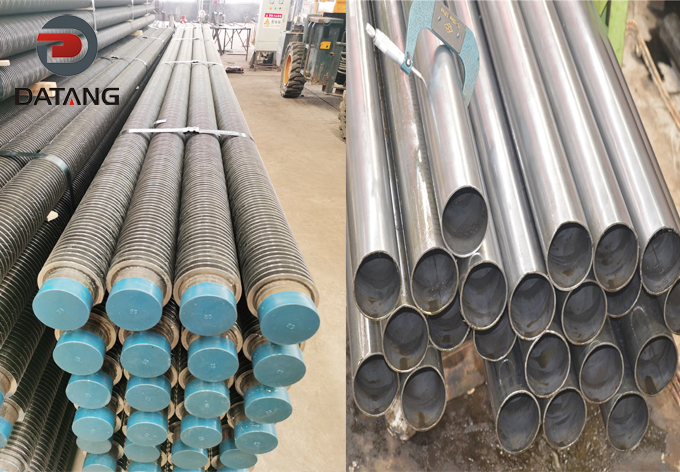
Bare Tubes: Best utilized in liquid-to-liquid heat transfer applications (such as classic shell-and-tube heat exchangers) where both fluids have similar, relatively high heat transfer coefficients.
-
Finned Tubes: Feature extended surfaces (longitudinal or spiral fins) to maximize heat transfer area. These are highly efficient for gas-to-liquid heat exchange (e.g., air coolers or condensers).Essential when one of the fluids is a gas (such as air or flue gas), which naturally has a low heat transfer coefficient. Adding fins—whether extruded, high-frequency welded (HFW), or laser-welded—increases the external surface area by up to 20 times. This allows for a significantly more compact and cost-effective heat exchanger design.
Finned Tubes vs Bare Tubes
Dimensional & Geometric Specifications
Getting the dimensions right ensures structural integrity and a perfect fit inside the tube sheet matrix:
-
Outer Diameter (OD) & Wall Thickness (WT): Thinner walls improve thermal conductivity but lower the pressure rating. High-pressure applications require precision heavy-wall tubes, while vacuum condensers benefit from thinner, high-efficiency options.
-
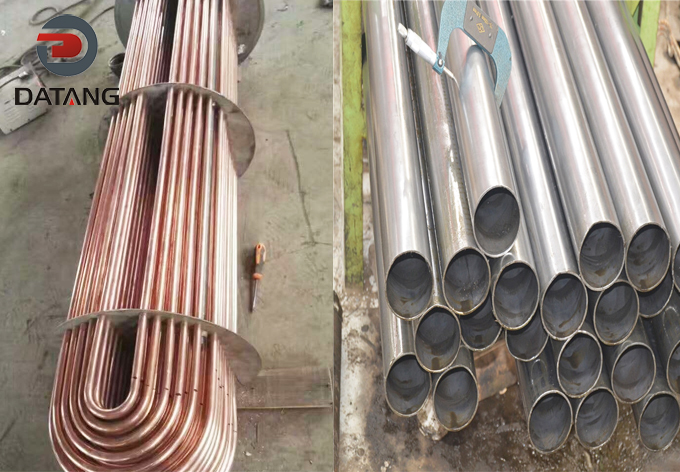
Straight vs. U-Bent Tubes: Straight tubes are easier to clean mechanically, making them ideal for fouling-prone fluids. U-bent tubes are preferred for high-temperature differentials because they allow for free thermal expansion without stressing the tube sheet joints.
Heat Exchanger Tubes Straight vs U-Bent Tubes
Manufacturing Quality and Compliance
A heat exchanger tube is only as reliable as its manufacturing standards. To avoid catastrophic field failures, ensure your supplier provides:
-
Strict compliance with international design codes (ASTM / ASME / EN).
-
Comprehensive Non-Destructive Testing (NDT), including Hydrostatic testing, Eddy Current testing, and Magnetic Particle Inspection (MPI).
-
100% traceable Mill Test Certificates (MTC) confirming exact chemical compositions and mechanical limits.
Need Expert Guidance?
Selecting the perfect tube requires balancing thermal performance, mechanical strength, and chemical resistance. If you need customized solutions tailored to your specific operational parameters, Datang Finned Tube is here to help. Contact our engineering team today for expert material recommendations and precision-manufactured heat exchanger tubes.
