


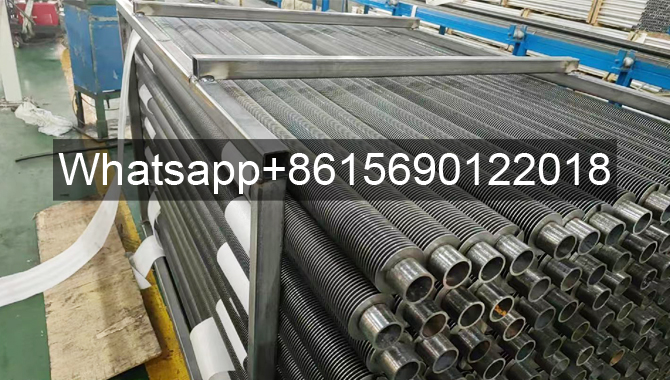
Welded on solid finned tube involves spirally winding the edges of finned strips around the circumference of a tube and continuously welding the finned strips to the tube. During the winding process, the finned strips maintain tension and are laterally constrained, ensuring tight contact between the finned strips and the tube wall. Continuous welding is performed at the point where the finned strips begin to bend around the tube diameter using Datang’s unique Gas Metal Arc Welding (GMAW) process.
This welding process achieves the industry’s strongest fin-to-tube connection, with excellent heat transfer performance, low fin-side pressure drop, and virtually unchanged grain microstructure and physical properties even when using tubes with 3%-9% chromium content.
Process: Solid metal strips are tightly wound in a spiral around a base tube.
Welding: Simultaneously with the winding, the fin roots are completely fused to the base tube surface and adjacent contact surfaces using high-frequency resistance welding (HFI), laser welding, or TIG/MIG welding.
Welded on Solid Finned Tube
Wrap-on (L/G Footed) Finned Tube
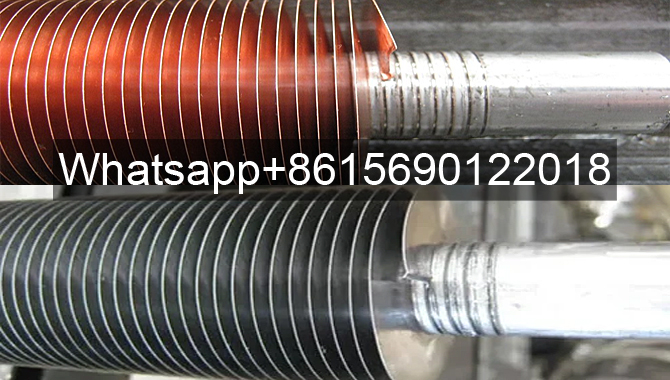
Extruded Fin Tube
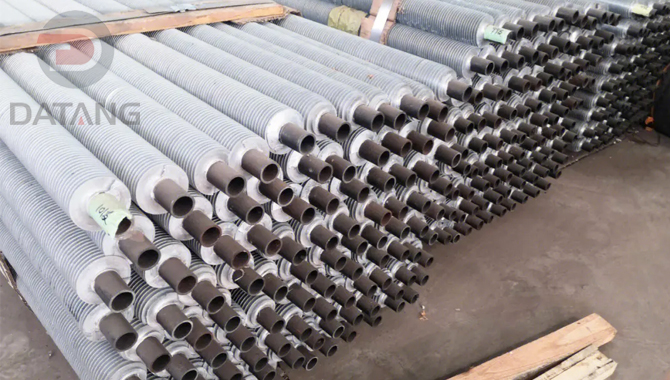
Comparison with Other Fin Types
| Feature | Welded on Solid Fin Tube | Mechanical Wrap-on (L/G Footed) | Extruded Fin Tube |
|---|---|---|---|
| Bonding Method | Metallurgical Weld (Fused) | Mechanical Tension/Embedment | Integral Extrusion (Aluminum clad) |
| Contact Resistance | Very Low (Near Zero) | Moderate (Can increase over time) | Low |
| Temp. Resistance | Very High (>400°C / 750°F) | Low/Medium (<250-300°C) | Medium (<200-250°C) |
| Pressure Resistance | High | Medium | Medium |
| Corrosion/Fouling | Excellent (No gaps) | Poor (Prone to root corrosion/fouling) | Good |
| Cost | Higher | Lower | Medium |
| Typical Use | Harsh conditions, High P/T | Standard HVAC, Low-temp heating | Corrosive gases, Food industry |
Key Features and Advantages of Welded on Solid Finned Tube
Due to the welding process, this type of tube offers the following significant advantages: Extremely high thermal conductivity: Because the fins and base tube are fused together, contact resistance is eliminated. Heat can be transferred unimpeded from the base tube to the fin tips.
High pressure and high temperature resistance: The welded structure is extremely robust and can withstand extremely high internal pressure and external temperatures, unlike mechanically wound tubes which may loosen or expand at high temperatures and fail.
Corrosion and wear resistance: The weld seam covers the entire contact area, preventing fluid from seeping into the fin roots and causing crevice corrosion. It is also ideal for applications prone to dust accumulation or requiring frequent cleaning (such as sonic soot blowing or high-pressure water washing).
Design Flexibility: Fin height, thickness, spacing (fins per inch), and materials can be customized to meet specific thermal requirements.
Common Applications of Welded Solid Finned Tubes
Due to their superior performance, welded solid finned tubes are widely used in harsh industrial environments:
Residual Heat Recovery Systems (HRSG): Heat recovery from gas turbine exhaust gases.
Petrochemical Industry: Heaters, coolers, and condensers, especially when handling corrosive media or high-temperature, high-pressure steam.
Power Industry: Boiler economizers and air preheaters.
Waste Incinerators: Due to the highly corrosive nature and dust content of the flue gas, the durability of the welded tubes is crucial.
HVAC (Large Industrial Air Conditioning): Steam heating coils.
