


What are low-fin tubes?
Low-fin tubes are heat exchange components in which fins of a specific height, pitch, and thickness are machined onto the outer surface of a plain tube through a mechanical rolling process. They are primarily manufactured using a three-roll cross-rolling method. The base tube and outer fins form a single integral structure, eliminating contact thermal resistance. They have a finning coefficient of 2-3, enhancing heat transfer by expanding the heat transfer area and stripping the flow layer. They also utilize thermal expansion and contraction to create a self-cleaning function, resulting in superior fouling resistance compared to plain tubes.
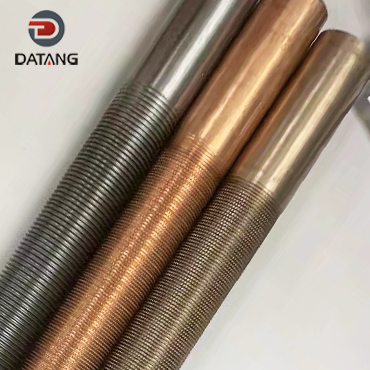
Low-fin tube parameters include fin height, pitch, and thickness. Fin efficiency decreases with increasing fin height. When used in condensers and oil heat exchangers, staggered tube bundles can be arranged to reduce the heat transfer area by 30%. Adding fins to the tubes effectively compensates for the low heat transfer coefficient on the air side. Materials include 304/316 stainless steel, steel pipe, duplex steel 2205, and titanium tubes, with standard outer diameters of 19mm and 25mm. The pressure drop across the tube increases exponentially with fin height. When the fin pitch exceeds 2mm, heat transfer performance decreases. Heat transfer efficiency is significantly affected by the fluid type, phase change state, and flow rate.
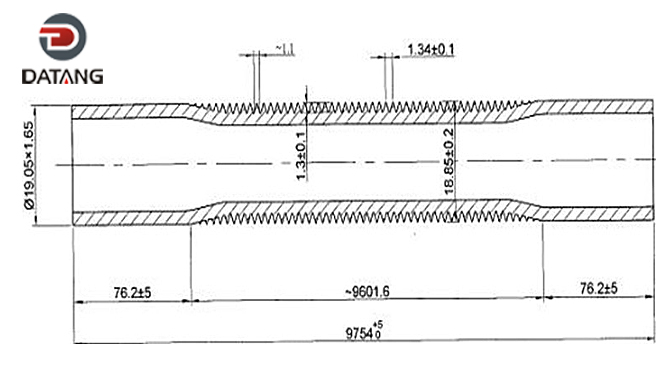
Low-fin tubes consist of a bare tube with fins attached to it. Structural parameters primarily include the inner and outer diameters, wall thickness, fin pitch, fin thickness, and fin height.
Low-fin tubes primarily utilize ribs on the outside of the tube (rib coefficient of 2-3) to increase the heat transfer area. Compared to bare tubes, they offer a greater surface area while consuming the same amount of metal.
From an intuitive perspective, this appears to be a primary heat transfer enhancement, but in reality, the increased heat transfer area also increases the heat transfer coefficient. The fins can separate the flow layer from the heat transfer surface, increasing surface disturbance and improving heat transfer efficiency, thus enhancing heat transfer and achieving a secondary heat transfer enhancement. The main factors influencing the heat transfer enhancement achieved by ribbed surfaces are fin height, fin thickness, fin spacing, and the thermal conductivity of the fin material.
Because one side of the heat transfer wall is expanded into a finned surface, convection heat transfer on the smooth side and heat conduction through the base wall all contribute to the overall heat transfer capacity. The fin spacing of low-fin tubes is determined based on the surface tension of the liquid and the shear force exerted on the liquid film by the flow.
Low-fin tubes also offer excellent fouling resistance, as fouling tends to form parallel flakes along the edges of wave crests. During operation, as the tube expands and contracts with temperature fluctuations, this “accordion-like” expansion and contraction prevents fouling.
On smooth tubes, fouling forms a cylindrical layer on the tube wall, with no natural mechanism to prevent fouling. Due to the low fin height, the cleaning method and difficulty of low-fin tubes are identical to those of smooth tubes.
Low-fin tubes are manufactured from ordinary smooth tube blanks through a simple rolling process. Their mechanical strength and corrosion resistance are comparable to those of the original smooth tube blanks, ensuring long-term, reliable operation of the heat exchanger.
Low Fin Tube Performance Parameters
Low-fin tubes have two key parameters that describe their performance: the fin ratio β and the fin efficiency η. The fin ratio, denoted by “β,” is defined by the formula: β = total surface area of the finned tube / original surface area of the tube. A larger β indicates a greater expansion of the finned tube’s heat transfer area, and thus enhanced heat transfer performance. During heat transfer in a finned tube, assuming the temperature of the fluid inside the tube is higher than that of the fluid outside, heat is transferred from the tube’s interior through the tube wall, from the fin root to the outside, along the fin’s height. Simultaneously, convection heat transfer occurs between the fin and the surrounding fluid, ultimately causing the fin temperature to gradually decrease along the fin’s height.
The gradual decrease in fin temperature along the fin’s height indicates a decreasing temperature difference between the fin and the surrounding fluid. According to the heat transfer equation for convection heat transfer, as the temperature difference decreases, the heat transfer per unit area of the fin also decreases. The taller the fins, the less effective their increased area is in enhancing heat transfer. Therefore, a new concept, fin efficiency η, is introduced.
η=Qactual/Qtheoretical
Where Qactual is the actual heat dissipation from the fin surface; Qtheoretical is the theoretical heat dissipation assuming the fin surface temperature is equal to the fin root temperature. If the fin efficiency is less than 1, then doubling the fin’s heat dissipation area does not double the heat dissipation. This “discount” in heat dissipation is the fin efficiency.
Fin efficiency is affected by factors such as fin height, thickness, and shape. Fin height has the greatest impact: greater fin height results in lower fin efficiency. This demonstrates that a larger fin’s heat transfer area does not necessarily translate into better heat transfer performance.
Low Fin Tube Manufacturing Process
Fin tubes can be processed in a variety of ways. Fins can be “bonded” to the base tube through welding, fitting, or inlaying, or they can be machined onto a plain tube through pressure processes like rolling and calendering.
Splitting-Extrusion Processing: This is a composite process that combines chipless cutting and extrusion. Finned tubes are machined on a conventional lathe using conventional cutting methods. After specialized tools split the metal on the tube surface, increasing extrusion causes the metal to flow radially and axially, plastically deforming the metal through these two extrusion processes to form fins.
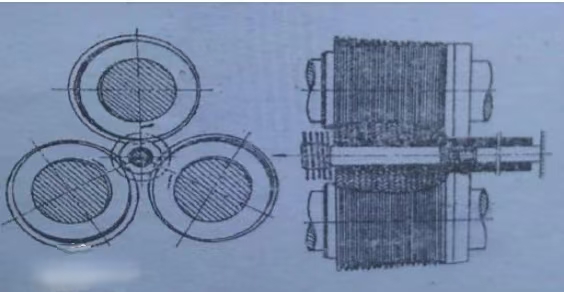
Low-fin tubes are produced using rolling (three-roll cross-rolling). The working principle is: a core rod is placed inside the plain tube. The tube material is driven by the roller blades in a spiral linear motion, and the fins are gradually machined onto the outer surface through the groove formed by the roller grooves and the core rod.
In order to facilitate fin forming, the rolled piece adopts three stages of biting, rolling and shaping during the deformation process, so that the processed fins are complete, smooth and regular. The fin tubes produced by this method have no contact thermal resistance loss and electrical corrosion problems because the base tube and the outer fin are an organic whole. It has good heat transfer efficiency and strong deformation resistance.
Enhanced Heat Transfer with Low Fin Tubes
Fin tubes transfer heat through convection. The mathematical expression for convection heat transfer, Q = hAΔT, shows that the amount of heat transferred is proportional to the heat transfer area A, the temperature difference ΔT, and the convection heat transfer coefficient h. Increasing the heat transfer area to increase heat transfer is an effective approach. However, simply increasing the volume of the equipment to gain more heat transfer area is not a viable approach in engineering applications. In practical applications, the only way to achieve this is to optimize the heat transfer surface structure to increase the heat transfer area per unit volume, thereby making the heat exchanger more compact and efficient. Currently, finned tubes, threaded tubes, and plate-fin heat transfer surfaces are commonly used to increase surface heat transfer.
Once the heat exchange element, heat transfer area A, and temperature difference ΔT are essentially determined, increasing heat transfer can be achieved by increasing the convective heat transfer coefficient h. When the finned-tube heat exchanger is operating stably and the finned tube wall thickness is relatively small, the convective heat transfer coefficient h can be approximately expressed as:
Where: h1—heat transfer coefficient of the fluid inside the tube; δ—tube wall thickness; h2—heat transfer coefficient of the fluid outside the tube; τ—thermal conductivity of the tube material.
Finned heat transfer tubes are typically made of metals with high thermal conductivity, such as copper and aluminum, and the tube wall thickness δ is relatively small. Therefore, the second term in the equation is negligible and small. The convective heat transfer coefficient can be simplified as h = (1/h1 + 1/h2) – 1. This shows that to increase the convective heat transfer coefficient h, the heat transfer coefficients of the fluids inside and outside the tube can be increased by increasing h1 and h2, respectively. When the values of h1 and h2 differ significantly, the overall heat transfer coefficient h is primarily determined by the smaller heat transfer coefficient, hmin. This indicates that increasing the smaller heat transfer coefficient significantly enhances heat transfer in finned tubes.
The convective heat transfer coefficient is primarily determined by the following factors:
First, the type and physical properties of the fluid. Different fluids (liquids or gases) have significantly different heat transfer coefficients.
Second, whether the fluid undergoes a phase change during the heat transfer process. If a phase change occurs, the heat transfer coefficient will be significantly improved.
Third, the flow rate of the fluid and the shape of the heat transfer surface.
Taking an air heater as an example, hot water flows through the tubes and air flows outside. Because the heat transfer coefficient on the air side outside the tubes is much lower than that on the water side inside the tubes, this hinders the heat transfer capacity of the water side. The “bottleneck” of the heat transfer process is on the air side outside the tubes, limiting the increase in heat transfer capacity. To overcome this “bottleneck” effect, fins are installed on the outside of the air-side tubes to significantly increase the heat transfer area outside the tubes, thereby compensating for the low heat transfer coefficient on the air side and greatly improving the heat transfer capacity.
Factors affecting low-finned tube heat exchangers
The main structural parameters of low-finned tubes are the inner diameter and outer diameter of the fin tube, the wall thickness of the fin tube, the fin pitch, the fin thickness and the fin height.
It is generally used in situations where the heat transfer coefficient inside the tube is more than 1 times greater than the heat transfer coefficient outside the tube. The most typical application is the oil heat exchanger. For condensation and boiling outside the tube, due to the effect of surface tension, it also has a good heat transfer enhancement effect.
(1) In terms of heat transfer effect, the primary and secondary relationship of the various structural parameters of low-finned tubes is: fin pitch → fin height → fin thickness. When the fin pitch is within 1~2 mm, the heat transfer performance of the finned tube increases with the increase of the fin pitch. When the fin pitch exceeds 2mm, the heat transfer performance decreases with the increase of the fin pitch; the heat transfer performance decreases with the increase of the fin thickness and increases with the increase of the fin height.
(2) The pressure drop outside the finned tube is significantly affected by the fin height. The pressure drop increases geometrically with the increase of fin height. The fin pitch also has a significant effect on the pressure drop. The pressure drop increases with the increase of fin pitch. The pressure drop is almost unaffected by the fin thickness.
(3) When the fluid flow rate inside and outside the tube increases, the heat transfer and pressure drop of the finned tube also increase. When the fluid flow rate outside the tube increases, the increase in pressure drop is significantly greater than the increase in heat transfer. When the flow rate inside the tube increases, the pressure drop outside the tube remains unchanged, and the increase in pressure drop inside the tube is small.