


What are serrated fins and solid fins?
Serrated Fins are characterized by their notched or sawtooth edges, which create structural variations in two airflow directions – on the side and the top. This design enhances turbulence when high-flow air or flue gas passes through, significantly improving heat transfer efficiency compared to traditional designs. The serrations create intense deflection in airflow patterns, disrupting boundary layers and promoting better thermal exchange.
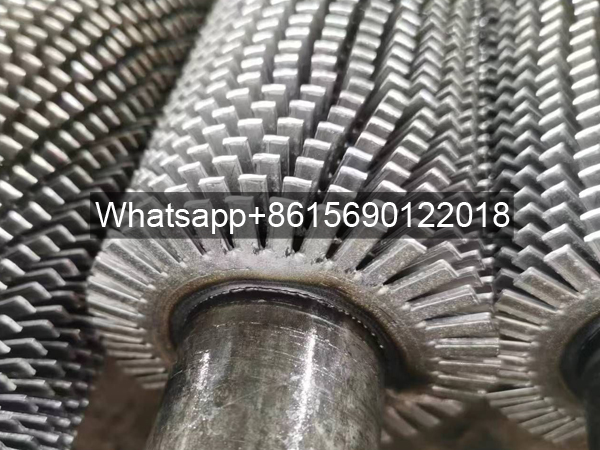
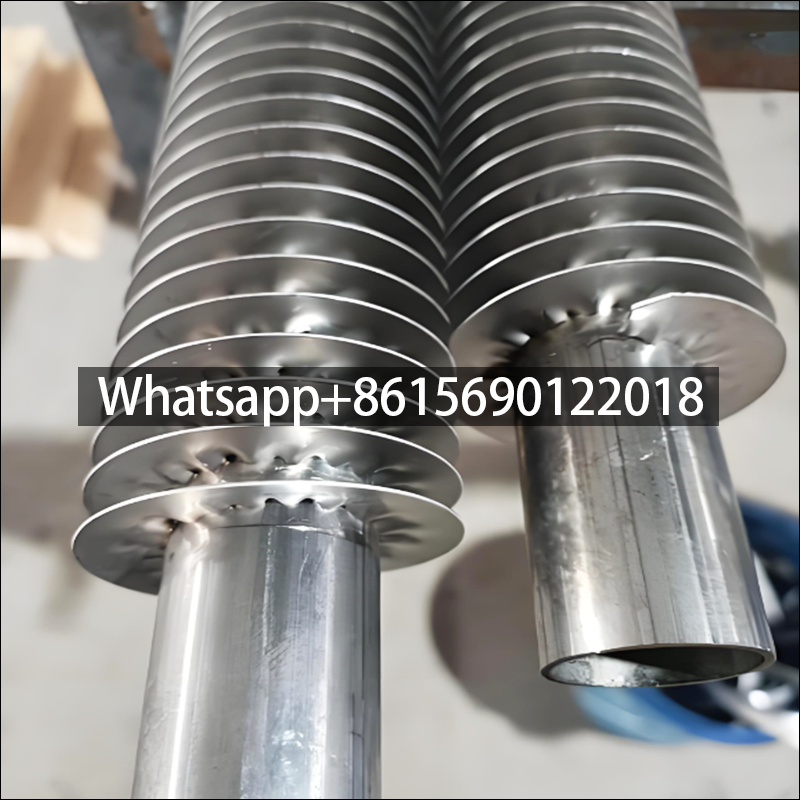
Solid Fins, in contrast, feature continuous surfaces without any notches or interruptions. These fins provide a straightforward, robust structure with consistent surface area for heat transfer. While they don’t create the same level of turbulence as serrated fins, their manufacturing simplicity and reliability make them widely used in many applications.
Manufacturing Processes
| Feature | Serrated Fins | Solid Fins |
|---|---|---|
| Primary Manufacturing Method | High-frequency welding, roll forming, or planing processes | Extrusion, stamping, or machining |
| Production Complexity | More complex due to precise notching | Simpler, more straightforward |
| Tolerances | ±0.02mm for height precision | More forgiving, ±0.1mm |
| Material Utilization | Slightly lower due to cutting | Higher material efficiency |
| Lead Time | 15-60 days for custom orders | Shorter, 15-30days |
Serrated fins often require specialized equipment for creating the precise notches, with processes like planing forming using multiple tools simultaneously to produce integral serrations. Solid fins benefit from more established manufacturing techniques like extrusion, where molten metal is forced through a die to create the desired profile.
Material Specifications
| Parameter | Serrated Fins | Solid Fins |
|---|---|---|
| Common Materials | Carbon steel, stainless steel, alloy steel,aluminum, copper | Carbon steel, stainless steel, alloy steel,aluminum, copper |
| Typical Thickness | 0.05-0.5mm (fins), 0.2mm (serrations) | 0.1-0.8mm |
| Thermal Conductivity | Aluminum: 167 WCo/(m·K) pper: 398 W/(m·K) |
Aluminum: 167 W 398 W/(>Copper:br/(m·K)<m·K) |
| Height Range | 2.5-11mm | 5-20mm |
| Pitch Range | Up to 10mm | Up to 15mm |
Both fin types utilize similar base materials, with aluminum alloys (6063, 6061) and copper being most common. The thermal conductivity values are identical between the two types since they’re using the same material classes. The key difference lies in the structural geometry rather than material properties.
Performance Advantages
Serrated Fins Offer:
- Higher Heat Transfer Efficiency: The notched design increases turbulence, improving heat transfer coefficients by 20-40% compared to solid fins in similar applications
- Better Airflow Stagnation Control: The stepped serrations help maintain air contact with the surface
- Compact Design Possibilities: Can achieve equivalent performance in smaller packages
Solid Fins Provide:
- Easier Manufacturing: No complex notching processes required
- Lower Production Costs: Simpler fabrication reduces expenses
- Robustness: Less prone to damage during handling
- Wider Availability: More suppliers offer standard solid fin components
Applications
Serrated Fins Are Preferred In:
- High-performance air-cooled heat exchangers
- Oil coolers for automotive applications
- Air preheaters in industrial systems
- Data center cooling solutions
- Aerospace thermal management
Solid Fins Dominate In:
- Standard HVAC heat exchangers
- Industrial process cooling
- Power electronics cooling
- Consumer electronics thermal management
- Cost-sensitive applications
A comparative study showed that while serrated fin heat exchangers offer 71% higher comprehensive performance factors than annular fin designs, they come with increased manufacturing complexity. This trade-off between performance and cost drives their application in different market segments.
Thermal Performance Comparison
| Metric | Serrated Fins | Solid Fins |
|---|---|---|
| Heat Transfer Coefficient | 20-40% higher | Baseline |
| Pressure Drop | 30-50% higher | Lower |
| JF Performance Factor | Up to 71% better than AFT | Standard |
| Temperature Uniformity | Better | Good |
| Fouling Resistance | Better due to turbulence | Standard |
The enhanced turbulence created by serrated fins not only improves heat transfer but also helps reduce fouling by preventing particle settlement. However, this comes at the cost of higher pressure drop, requiring more powerful fans in some applications.
Cost Analysis
- Manufacturing Cost: Serrated fins are 20-30% more expensive to produce due to complex machining
- Material Cost: Similar for equivalent materials
- System Cost: May allow for smaller heat exchangers, offsetting some cost
- Maintenance Cost: Serrated designs may require less frequent cleaning
A cost-performance analysis shows that while serrated fin heat exchangers have higher upfront costs, their efficiency gains can provide lifecycle savings in energy-intensive applications.
Conclusion
The choice between serrated fins and solid fins ultimately depends on the specific application requirements. Serrated fins excel in high-performance thermal management where space constraints and efficiency are critical, while solid fins remain the workhorses for cost-sensitive and standard applications. Understanding these differences allows engineers to select the optimal fin design for their particular thermal challenges.