


In the design of heat exchangers, the choice between longitudinal and transverse fins mainly depends on the fluid flow direction and the specific application of the heat exchanger. Longitudinal and transverse fins are two basic fin arrangements in finned tube heat exchangers, and their core differences lie in the fin arrangement direction, applicable airflow scenarios, and heat exchange characteristics.
1. Structure and Orientation
-
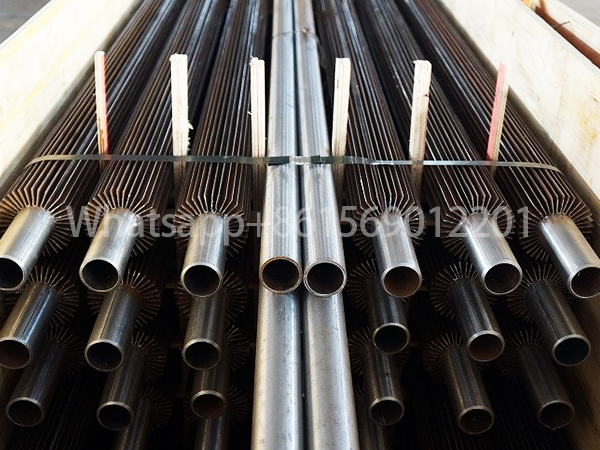
Longitudinal Fins: These fins run parallel to the axis of the tube. They are typically straight strips welded or embedded onto the outer surface of the base tube.
-
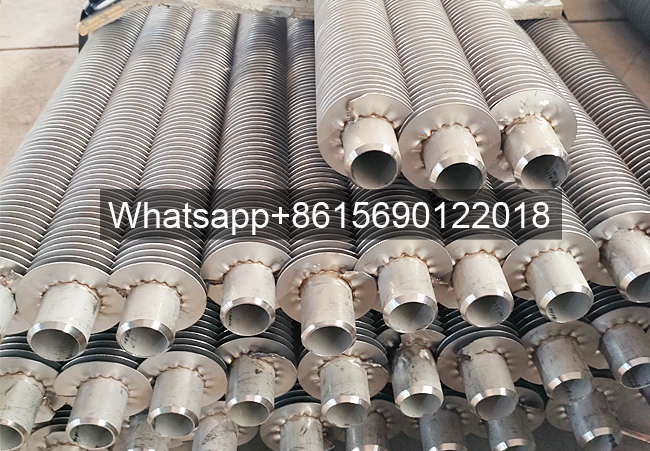
Transverse Fins: These fins are oriented perpendicular to the tube axis. The most common form is the circular or spiral-wound fin (helical), which appears like “disks” stacked along the tube.
Datang Longitudinal Finned Tubes
Datang Transverse/Spiral Finned Tubes
2. Fluid Dynamics (Flow Direction)
-
Longitudinal Fins: Best suited for cases where the external fluid flows parallel to the tube. Since the fins are aligned with the flow, they offer minimal resistance (pressure drop).Such as in heat exchangers paired with axial fans.However, the extended heat transfer surface area is limited (typically 3 to 5 times that of a bare tube), resulting in relatively lower heat transfer efficiency.
-
Transverse Fins: Best suited for cases where the external fluid flows across the tube bundle (perpendicular to the tube). As the fluid passes through the circular fins, it creates significant turbulence, which breaks the boundary layer and enhances heat transfer.such as in centrifugal fan systems, air-cooled condensers, and similar applications. When flue gas or air sweeps across the fin surfaces, it generates significantly stronger turbulence; in boiler economizers, this results in a heat transfer efficiency that is more than 20% higher than that of longitudinal fins.
Characterized by a large heat exchange surface area and excellent resistance to fouling, they are widely utilized for heat exchange involving high-flow-rate, low-viscosity fluids.
3. Key Performance Comparison
| Comparison Dimension | Longitudinal Fins | Transverse Fins |
|---|---|---|
| Structural Feature | Fins are parallel to the heat exchange tube axis. | Fins are perpendicular to the heat exchange tube axis. |
| Airflow Resistance | Low. Air flows smoothly with no significant obstruction. | High. Air must bypass the fins, generating more turbulence and resistance. |
| Heat Transfer Efficiency | Moderate. Large surface area, but relatively less airflow disturbance. | High. Strongly disturbs airflow, destroys thermal boundary layers, and enhances heat transfer. |
| Typical Application | Double-pipe or shell-and-tube exchangers |
4. Typical Application Scenarios
Datang Longitudinal Finned Tubes
Due to their low resistance characteristics, they are frequently used for high-viscosity fluids (such as heavy oil or lubricants) in cooling or heating processes. In “Hairpin” or double-pipe heat exchangers, longitudinal fins allow oil-based fluids to achieve sufficient heat transfer area while maintaining a low pressure drop.Chemical cooling systems, hot air furnaces, air conditioning units (with axial fans)
Datang Transverse/Spiral Finned Tubes
This is the most common type used in industrial sectors. They are widely applied in gas-to-liquid heat exchange, such as air-cooled heat exchangers for generator sets and boiler economizers. Since the heat transfer coefficient on the gas side is usually much lower than the liquid side, transverse fins compensate for this by providing a high “fin ratio” (surface area expansion).
5. Selection Recommendations
If the system prioritizes low resistance, dust resistance, and impact resistance, longitudinal fins are preferred.
If high heat transfer efficiency, compact structure, and the ability for airflow to pass vertically through the tube bundle are desired, transverse fins are superior.
