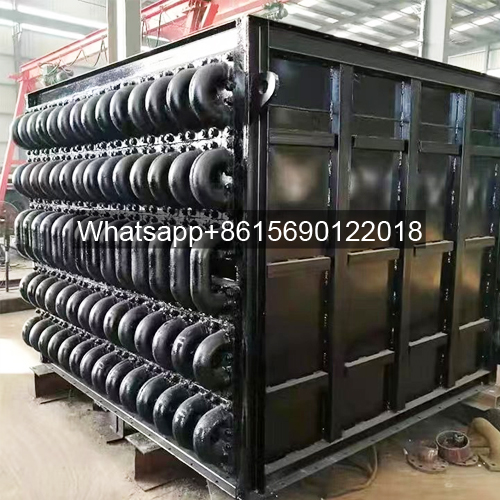


A boiler economizer can operate independently without being forced to use it in conjunction with the steam drum. Its independent operation requires meeting the following conditions to maximize its advantages:
I. Core Conditions for Independent Operation of a Boiler Economizer
Embassy of the Boiler Economizer’s Feedwater System
The boiler economizer must be equipped with a continuous feedwater device (such as a water pump) to ensure a stable water flow within the economizer. Non-boiling economizers need to heat the water to 40-50°C below the saturation temperature to prevent vaporization; boiling economizers need to evaporate 10%-15% of the water into steam at the boiler’s operating pressure, and continuous feedwater is essential.A boiler economizer acts as a bridge between that waste heat and your incoming water supply. Instead of letting that heat escape, the economizer captures it and transfers it to the boiler feedwater before it enters the main boiler drum.
Safety Protection Measures for the Boiler Economizer
Pressure Control: A safety valve is installed on the economizer’s outlet water pipe to prevent high-pressure water damage to the equipment in case of valve malfunction.
Overheat Protection: A bypass flue or recirculation pipe is installed to prevent overheating of the pipe walls due to stagnant water within the economizer during boiler startup. For example, by closing the flue damper and opening the bypass flue, the flue gas bypasses the economizer.
Corrosion Protection Design of Boiler Economizers: Controlling the temperature of the flue gas flowing through the economizer above the dew point (typically >120℃) prevents condensation on the tube walls from combining with sulfides to form sulfuric acid, leading to ash corrosion.
Ash Accumulation and Wear Prevention in Boiler Economizers
Flue Gas Velocity Optimization: Reducing ash accumulation and blockage through optimized flue gas velocity design (typically ≥6m/s). For example, H-type finned tube economizers reduce the risk of ash accumulation by increasing flue gas turbulence.
Abrasion-Resistant Structure: Baffles are installed between the economizer’s serpentine tube bends and the casing to uniformly distribute the flue gas velocity; abrasion-resistant covers are placed on the tube bends near the rear wall to reduce fly ash abrasion.
II. Technical Advantages of Independent Operation of Boiler Economizers
Enhanced Flexibility
Space Optimization: Independent economizers can be flexibly arranged at the end of the flue or in independent spaces, avoiding integration with complex structures such as the steam drum, simplifying system design. For example, in fire-tube boilers, the economizer is independently installed at the end of the flue, facilitating maintenance and repair.
Adaptability to Special Operating Conditions: Suitable for special operating conditions (such as low-temperature waste heat recovery), without being limited by steam drum parameters. For example, low-temperature economizers can recover waste heat from flue gas at 125-150℃, improving boiler efficiency by 5%-8%.
Reduced Cost of Boiler Economizers:
Reduced Equipment Investment: Eliminating complex structures such as steam drums reduces equipment manufacturing and installation costs. For example, using an independent economizer in a small boiler can save approximately 20% on steam drum investment.
Improved Operating Efficiency: Optimizing the matching of water velocity and flue gas velocity reduces water resistance and flue gas pressure drop. For example, the water velocity in a non-boiling economizer is controlled at 0.3-0.5 m/s, and in a boiling economizer, the water velocity is ≥1 m/s, ensuring thermal efficiency.
Enhanced Maintenance Convenience of Boiler Economizers:
Independent Maintenance: In case of economizer failure, isolation can be achieved by closing the inlet and outlet valves, without shutting down the entire boiler system. For example, low-temperature economizers are equipped with bypass water pipes; in case of failure, feedwater enters the boiler drum directly through the bypass, ensuring continuous boiler operation.
Reduced Cost of Boiler Economizers:Easy Cleaning: Independent economizers can be flushed with water or chemically cleaned independently, extending equipment life. For example, water flushing can be used during unit maintenance, while a sewage discharge system is installed to remove wastewater.
III. Typical Application Scenarios of Boiler Economizers
Fire-tube Boilers: The economizer is independently installed at the end of the flue, achieving heat exchange through counter-current flow of flue gas and water, reducing the exhaust gas temperature to below 150℃ and improving thermal efficiency by 8%-10%.
Low-Temperature Waste Heat Recovery System: Independent low-temperature economizers recover waste heat from the flue gas before the dust collector, heating condensate to 70-90℃, reducing the load on the turbine’s low-pressure heater, and achieving energy saving and efficiency improvement.
Small Industrial Boilers: Utilizing independent non-boiling economizers, continuous feedwater and safety valve protection ensure safe and stable operation, while reducing nitrogen oxide emissions by 15%-20%.
IV.The Step-by-Step Process
Exhaust Recovery: As hot flue gases (often resulting from the combustion of natural gas) travel toward the chimney, they pass through the economizer unit.
Heat Transfer: Inside the economizer, the gas moves over a series of finned tubes. These tubes contain the relatively cool boiler feedwater. Through the process of heat transfer, the thermal energy from the gas is absorbed by the water.
Pre-Heating: By the time the water leaves the economizer, its temperature has increased significantly.
Reduced Load: Because the water is already hot when it reaches the boiler, the system requires far less fuel to reach the final steaming temperature.
V.Why Quality Finned Tubes are Critical
The efficiency of the heat transfer process depends heavily on the surface area and material of the tubes inside the economizer. Using specialized finned tubes—such as H-fin or spiral fin designs—drastically increases the contact area, allowing for maximum heat recovery even in compact spaces.
By investing in a high-performance economizer, you aren’t just buying equipment; you are implementing a long-term strategy for energy conservation and cost reduction.
Cast Iron Finned Tubes for Waste Heat Recovery-Boiler Economizer