


H-type finned tubes are the core heat exchange element of boiler economizers. Their structural feature is the symmetrical welding of rectangular fins to both sides of the base tube, forming an “H”-shaped cross-section. This design significantly improves heat transfer efficiency by increasing the heat exchange area (up to 3-4 times that of a bare tube) and optimizing the airflow path.
To achieve a compact heating surface structure, reduce volume, and minimize material consumption, Datang employs an extended heating surface to enhance heat transfer. H-type finned tubes, as heat exchange elements, are widely used in power plant boilers, the design and retrofitting of conventional boiler economizers, and other waste heat boiler heat exchange equipment due to their simple manufacturing process and ability to increase the external heat exchange area and enhance heat transfer.
Square H Finned Tube Fin outer diameter detection
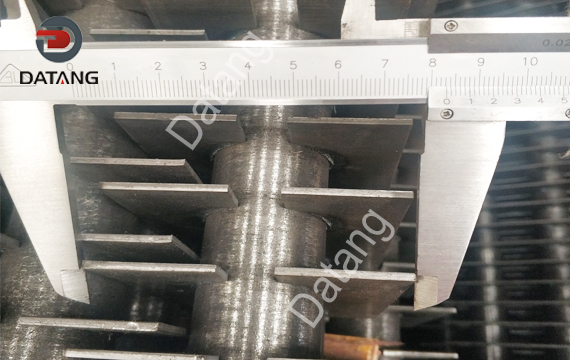
In economizer applications, H-type finned tubes offer the following advantages:
High wear resistance: The parallel arrangement of fins divides the flue into smaller areas, reducing turbulent wear and extending service life by 3-4 times compared to traditional spiral finned tubes.
Self-cleaning capability: The 4-10mm fin gap guides airflow to blow away accumulated ash, reducing maintenance frequency.
High space utilization: The compact design is suitable for space-constrained scenarios such as boilers.
Typical applications include power plant boiler economizers and chemical heat exchangers. Customization is available in various materials such as carbon steel and stainless steel.
H-type fin tube manufacturing Machine
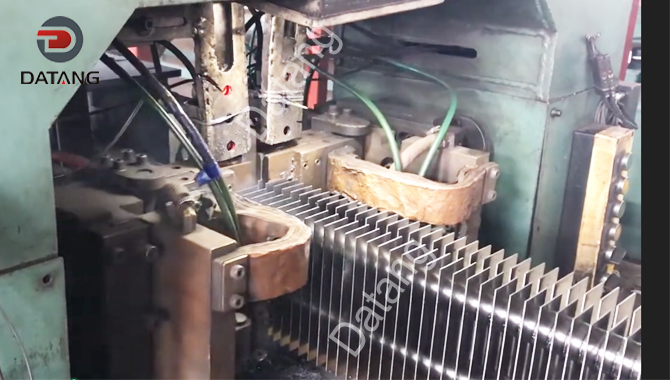
The main industrial applications of H-type finned tubes include:
H-type Finned Tube Power Industry
Used in power plant air-cooling systems to reduce turbine exhaust temperature.
As economizers and air preheaters in boilers, improving coal combustion efficiency.
Used in nuclear power plant reactor cooling systems.
H-type Finned Tube Petrochemical Industry
Used in heat exchangers to cool high-temperature oil and gas or heat low-temperature media.
As a core component of reboilers and condensers in oil refineries.
Used in crude oil heating and transportation systems.
H-type Finned Tube Metallurgical Industry
Heat exchangers for blast furnace hot blast stoves, capable of withstanding 1200℃ high-temperature flue gas.
Oil cooling systems in steel rolling production lines.
Blast furnace gas waste heat recovery systems.
Structural Features of H-type Finned Tubes
1. The fins are divided into two symmetrical halves, pressed tightly against the tube wall from both sides using resistance welding, leaving a certain gap in the middle;
2. Two round tubes can share a set of fins, called a double-tube H-type finned tube, or only one round tube can be placed in the middle, called a single-tube H-type finned tube;
3. Heat exchangers composed of H-type finned tubes are tightly arranged, with the tube bundles arranged in a straight line.
H-type Finned Tubes for Boiler Economizers Packaging
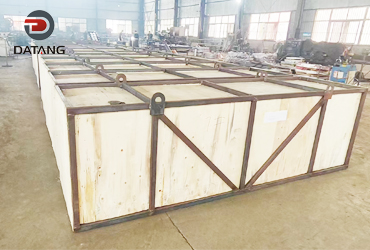
The Influence of H-Type Fin Structure on Ash Accumulation and Wear
1. The gap between the two fins utilizes the flow of flue gas and the flushing of accumulated ash, as the flue gas has a higher flow velocity at the gap; the tubes are arranged in a straight line, resulting in low resistance and minimal wear.
2. H-type fins can utilize the flow space, maintaining a larger fin area and fin-to-weight ratio.
3. The fin thickness can be arbitrarily selected according to the required wear level.
4. The fins are parallel to each other and do not interfere with each other, without the influence of helix angle, thus facilitating ash removal.
