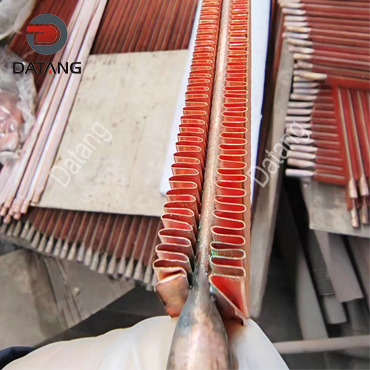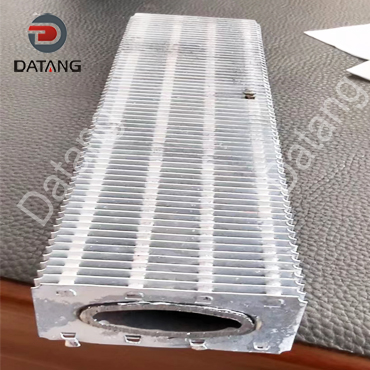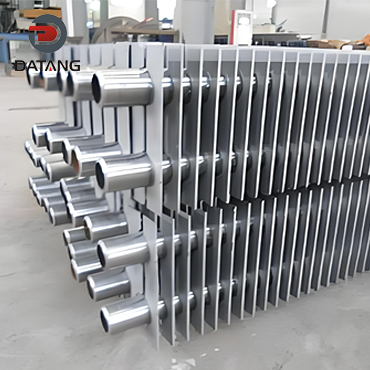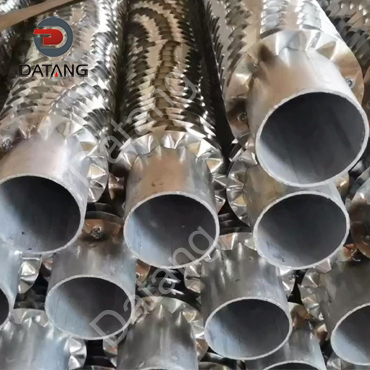


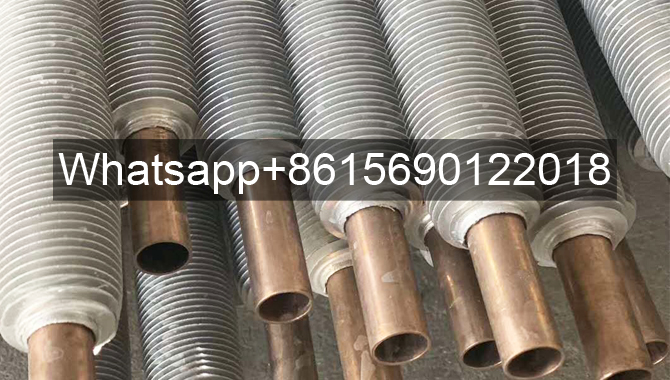
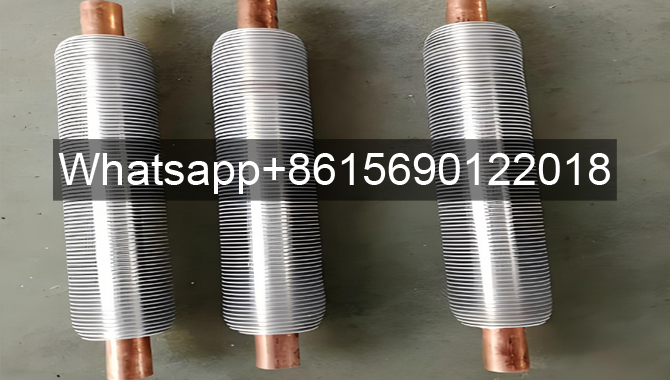
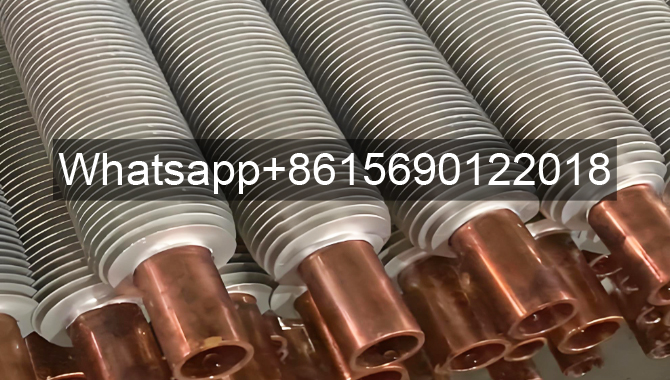
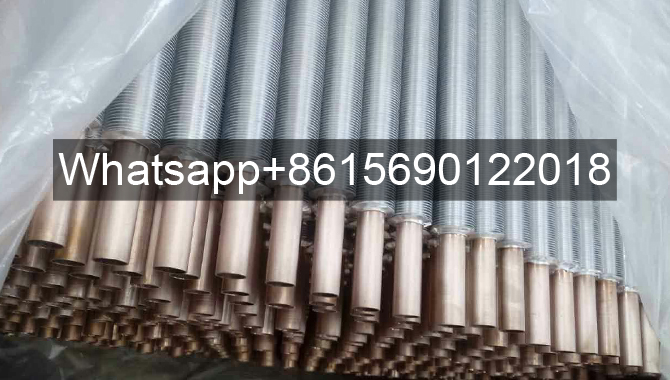
Extruded Fin Tube Copper Tube Aluminum Fins
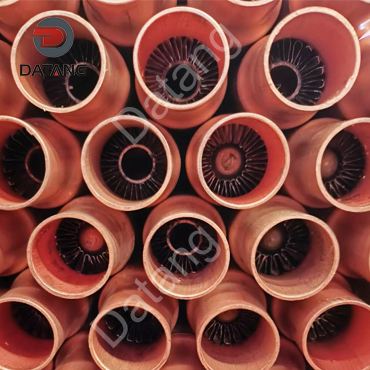
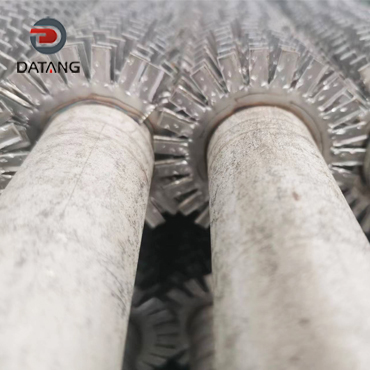
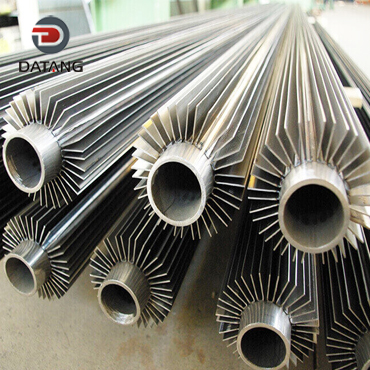
Copper tube aluminum fin extruded fin tubes are high-efficiency heat exchange elements that combine a copper base tube with aluminum fins into an integrated structure through a special extrusion process.
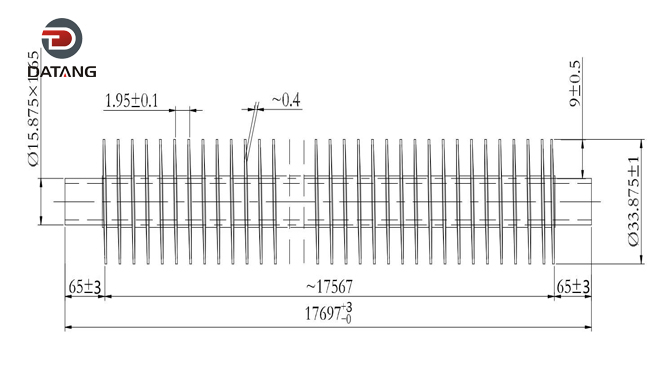
- Tube Material:Carbon steel,Stainless steel,Tube Diameter:15.88-50.80 mm,Wall Thickness:1.0-3.0 mm
- Fin Material:Aluminum,Cooper,Fin Thickness:0.4-0.5 mm,Fin Pitch:2.1-6.0 mm,Fin Height:6.35-25.4 mm
What is an Extruded Fin Tube Copper Tube Aluminum Fins?
Copper tube aluminum fin extruded fin tubes are high-efficiency heat exchange elements that combine a copper base tube with aluminum fins into an integrated structure through a special extrusion process.
Working Principle of Copper Tube Aluminum Fin Extruded Fin Tubes
The base tube uses copper to utilize its excellent thermal conductivity (high thermal conductivity coefficient), while the fins use aluminum to take advantage of its lightweight, low cost, and resistance to atmospheric corrosion. During manufacturing, an extrusion die is used to coat the aluminum material onto the surface of the copper tube, forming a strong metallurgical bond with no gaps, thus efficiently expanding the heat transfer area and rapidly conducting heat.
When a heat transfer medium (such as steam or hot water) flows inside the tube, heat is transferred through the copper base tube wall to the aluminum fins, and then heat exchange occurs with the fluid outside the tube (such as air), enhancing heat transfer efficiency.
The main features and advantages of copper tube aluminum fin extruded fin tubes include:
High performance: The copper base tube ensures high thermal conductivity and pressure resistance, while the aluminum fins enhance the overall heat dissipation capacity, resulting in low contact thermal resistance and excellent heat transfer performance.
Structural reliability: The extrusion process achieves integrated molding of the fins and base tube, resulting in high bonding strength, resistance to detachment, and the ability to withstand high-pressure flushing and temperature fluctuations.
Wide range of applications: Suitable for industrial heat exchange systems, such as refrigeration and air conditioning, power metallurgy, and petrochemical industries, especially in scenarios where space is limited or high-efficiency heat dissipation is required.
What is a bimetallic rolled fin tube?
A bimetallic rolled fin tube also called extruded finned tube,it consists of a base tube and fins wrapped around it. The base tube is usually a carbon steel tube, stainless steel tube, or copper tube, with an aluminum tube fitted over it. A special rolling mill then extrudes the aluminum tube into fins, simultaneously forming a thin base layer on the outside of the base tube, tightly wrapping it.
Extruded fin tube rolling method:
This method involves inserting a mandrel into the bimetallic composite tube. The composite tube is then processed through a die cavity formed by the rolling mill’s blades and the mandrel, creating fins on its outer surface. The heat transfer tubes produced by this method have the outer tube and fins as an integral unit, thus eliminating contact heat loss and resulting in excellent performance and high heat transfer efficiency.
As the rolling reduction increases, both the outer fin height and the inner rib height increase. According to the metal flow laws during rolling, increasing the reduction increases the depth of the blade’s penetration into the copper tube. Due to the limitations of the rolling shape, the radially compressed metal cannot flow axially, so it is forced to flow into the gaps between the rolling mill blades, which have less resistance, thus increasing the outer fin height.
As the rolling reduction increases, the rolling extrusion force on the inner aluminum tube also increases. Under the action of circumferential extrusion force, the radially compressed metal flows into the grooves of the inner spiral mandrel, increasing the metal filling rate in the grooves, thus increasing the inner rib height. Therefore, increasing the rolling reduction is beneficial for increasing the outer fin height and inner rib height of the finned tube, meeting the requirements for improved heat transfer performance.
However, a larger rolling reduction is not always better, because a larger reduction requires a correspondingly larger rolling force. If this force exceeds the deformation resistance of the outer metal layer, it can lead to jamming.
To ensure the smooth assembly of the heat transfer tube, the outer diameter of the composite finned tube should be slightly smaller than the outer diameter of its smooth tube blank. If the reduction is too large, the fin height may increase excessively, potentially exceeding the required specifications.
- Datasheet
- Drawing
- Certificates
| Extruded Fin Tube Copper Tube Aluminum Fins | ||
| Tube OD | 10~51 (mm) | 0.4”~2” |
| Tube Wall Thk | 1.65~3.0 (mm) | 0.065”~0.118” |
| Tube Length | ≤18,500 (mm) | ≤60.7 ft |
| Fin Thk | 0.3~1.2 (mm) | 0.012”~0.047” |
| Fin Height | 5~16 (mm) | 0.2”~0.63” |
| Fin Pitch | 100~555 (mm) | 3~14 FPI |
| Fin Type | Extruded | |
| Material Combinations | ||
| Fin Material | Aluminum (most common grade:Alu.1100, Alu.1060, Alu. 6063) | |
| Copper | ||
| Tube Material | C.S. (most common grade: A179, A192,SA210 GrA1/C,A106 Gr B ) | |
| S.S. (most common grade: TP304, 316, 321, 347,A789) | ||
| Copper (most common grade:UNS12200,14200, 70600, CuNi70/30, CuNi 90/10) | ||
| Titanium (most common grade: B338Gr2) | ||
| Applied Temperature | 300°C | |
| Type of Service | Medium temperature, severe atmospheric corrosive environment. | |

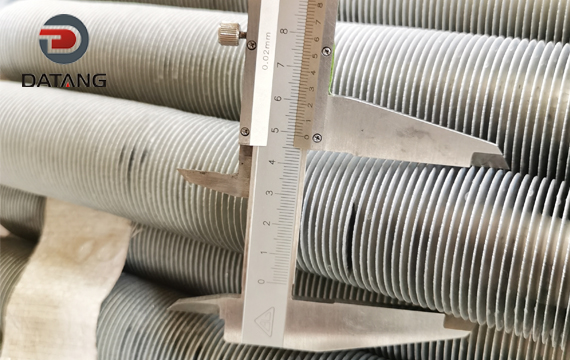
Extruded Fin Tube Copper Tube Aluminum Fins Appearance Dimension Inspection
Extruded fin tube copper tube aluminum fins appearance dimension inspection is one of the important links to ensure the quality and performance of fin tubes.
The inspection items mainly include fin height, fin spacing, fin thickness, base tube wall thickness and outer diameter, etc.
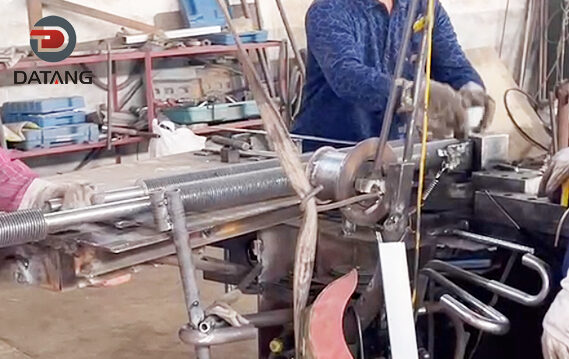
Datang Extruded Fin Tube Copper Tube Aluminum Fins Bending Processing
Bending of fin tubes is an important step in the production process of extruded fin tube copper tube aluminum fins. Bending is to bend the extruded finned tubes material through specific mechanical equipment to form a suitable curvature to meet different usage requirements.
This step requires strict control of the bending angle and curvature to ensure the fit between the fin and the base tube and the heat dissipation effect.
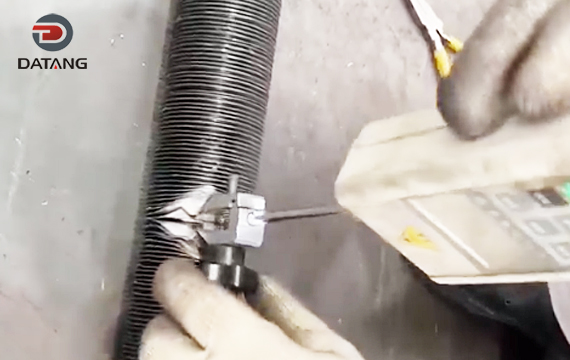
Extruded Fin Tube Copper Tube Aluminum Fins Pull Off Test
Extruded fin tube copper tube aluminum fins pull-off test is a test used to detect whether the fin tube will fall off when subjected to tension, mainly used to ensure the quality and reliability of the fin tube.
Datang’s this test is very important in the production process because the extruded finned tubes will be subjected to various stresses during operation, such as temperature changes and pipe expansion, which may cause the fin to fall off, thereby affecting the performance and safety of the heat exchanger .